
by Somipriyo Mukherjee, Dec 27, 2025
According to Theosophical teachings, there exists a true Esoteric Buddhism totally distinct from all publicly known Buddhist systems, including Tibetan Vajrayana. This esoteric tradition is said to preserve the original inner teachings of Gautama Buddha, transmitted secretly through a Trans-Himalayan Brotherhood of Adepts, known in Theosophy as “the Masters.”
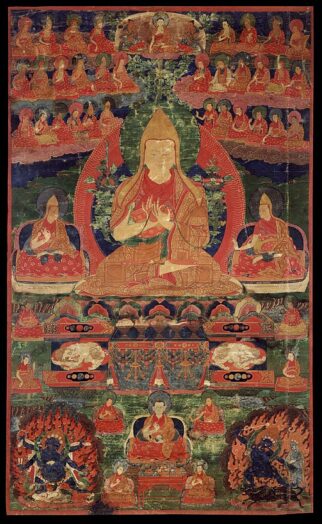
Though today, Vajrayāna Buddhism presents itself as the innermost teaching of the Buddha, Theosophy regards it as the outer shell of an inner fire long withdrawn—an ecclesiastical mirror of Rome, a Buddhist Papacy administering rites where once Adepts transmitted Truth in silence. An institutionalised Papacy of ritual, lineage, and authority, standing where the living fire of Esoteric Buddhism once burned unseen.
Central to this tradition is Tsong-Kha-Pa (1357–1419), founder of the Gelugpa (Yellow Hat) school of Tibetan Buddhism. Theosophy regards him as an extraordinarily advanced being who sought to purify Buddhism in Tibet by reforming corrupted practices, exiling degenerate clergy, and restoring spiritual discipline.
A 1876 book by Clements R. Markham, Narratives of the Mission of George Bogle to Tibet, and of the Journey of Thomas Manning to Lhasa, says this:
“In the middle of the fourteenth century a great reforming Lama arose in Tibet, named Tsong-khapa, who proved to be an incar- nation of one of the Dhyani Buddhas, named Amitabha. . . . He forbade clerical marriages, prohibited necromancy, and intro- duced the custom of frequent conferences among the Lamas. His reforms led to a schism in the Tibetan church. The old sect, which resisted all change, adhered to their dress, and are called Shammars, or Dukpas, and Red Caps. Their chief monastery is at Sakia-jong, and they retain supremacy in Nepal and Bhutan.”
HPB repeatedly distinguishes exoteric RELIGIOUS Buddhism—institutional, ritualistic, and often corrupted—from real Esoteric Buddhism, which she describes as preserved in secrecy and known only to Initiates. She is sharply critical of popular Lamaism (Tibetan Buddhism), stating that most clergy, even within the Gelugpa order, lack genuine esoteric understanding and would not recognize the Masters even if they encountered them.
There is no fault in walking the outer paths of Buddhism—Theravāda, Mahāyāna, or Vajrayāna—for they serve as skillful rafts upon the river of becoming. Yet one must not mistake the raft for the shore. None of these exoteric systems is the Ultimate Truth.
As H. P. Blavatsky affirmed with timeless clarity, “There is no Religion higher than Truth.” To approach that Truth, one must step beyond religion itself—beyond names and forms, beyond robes and rituals, beyond hierarchies of rank and authority.
The seeker must transcend the ladders of levels, the pageantry of pūjās, and the cult of gurus, rinpoches, and institutions, entering instead the silent domain where Truth stands unmediated and sovereign.
Had Truth been absolute in its institutional expressions, Je Tsongkhapa would not have incarnated to restore and purify Tibetan Buddhism from corruption & black magic.
Tsongkhapa (1357–1419) believed Tibetan Buddhism had drifted into:
- Lax monastic discipline
- Tantric practice divorced from ethics
- Philosophical confusion, especially around Madhyamaka and emptiness
- Sorcery & Necromancy
His project was to re-establish rigor, not create a new Buddhism.
His key reforms:
Strict Vinaya observance (monastic discipline as non-negotiable)
Gradual path (Lamrim) before tantra
Correct Madhyamaka view based on Nāgārjuna and Candrakīrti
Tantra grounded in renunciation, bodhicitta, and correct view.
Strict cultivation of ethics.
However, several of the older Tibetan Buddhist traditions, including the Nyingma lineage and the Drukpa Kagyu, refused to reorganize themselves according to the reformist framework proposed by Tsongkhapa. Consequently, his vision did not replace the existing schools but instead solidified into a new and separate tradition: the Gelugpa.
This history ultimately points to a simple truth: the Dharma was never meant to be confined by sects, institutions, or guru-domination. Lineages—Gelug, Nyingma, Kagyu, Sakya—are historical forms shaped by time and temperament. They are not the Truth itself.
To mistake a lineage for the Dharma is already to miss the Buddha’s intent. The Buddha did not ask for blind loyalty, but for investigation, verification, and direct seeing. Studying Buddhism honestly therefore means studying it historically and critically, seeing both its realizations and its institutional shadows.
Sectarianism narrows vision. Guru-worship that silences inquiry weakens the Path. When obedience replaces discernment, Dharma turns into ideology.
The Bodhisattva vow says: “The dharmas are boundless; I vow to master them.”
Truth is not owned by any lineage. If it is truth, it can appear anywhere—through the Buddha’s sutras, Hindu wisdom, Christian mysticism, Theosophy, or other genuine paths—once we let go of name, form, and institutional identity.
To walk the Bodhisattva path is to remain rooted in the Buddha’s teachings while standing free of sectarian pride, guru-dependence, and fear—loyal not to schools, but to truth itself.
Comment by Jeff Whittier
HPB may have claimed that esoteric Buddhism was totally distinct from publicly known Buddhist systems, but the Maha Chohan in his letter to the TS refuted this view. Here’s the relevant passages –
“H. S. O. who works but to revive Buddhism may be regarded as one who labours in the true path of Theosophy, far more than any other man who chooses as his goal the gratifications of his own ardent aspirations for occult knowledge. Buddhism stripped of its superstitions is eternal truth, and he who strives for the latter is striving for Theo-Sophia, Divine Wisdom, which is a synonym for truth.
“All of us have to get rid of our own ego, the illusory apparent self, to recognise our true self in a transcendental divine life. But if we would not be selfish we must strive to make other people see that truth, to recognise the reality of that transcendental self, the Buddh, the Christ or God of every preacher. This is why even exoteric Buddhism is the surest path to lead men toward the one esoteric truth.”
- View of the Chohan on the T.S., Letter to Alfred P. Sinnett, received Simla, August 27+, 1881.