
May 8, 2022
Last change: October 03, 2026
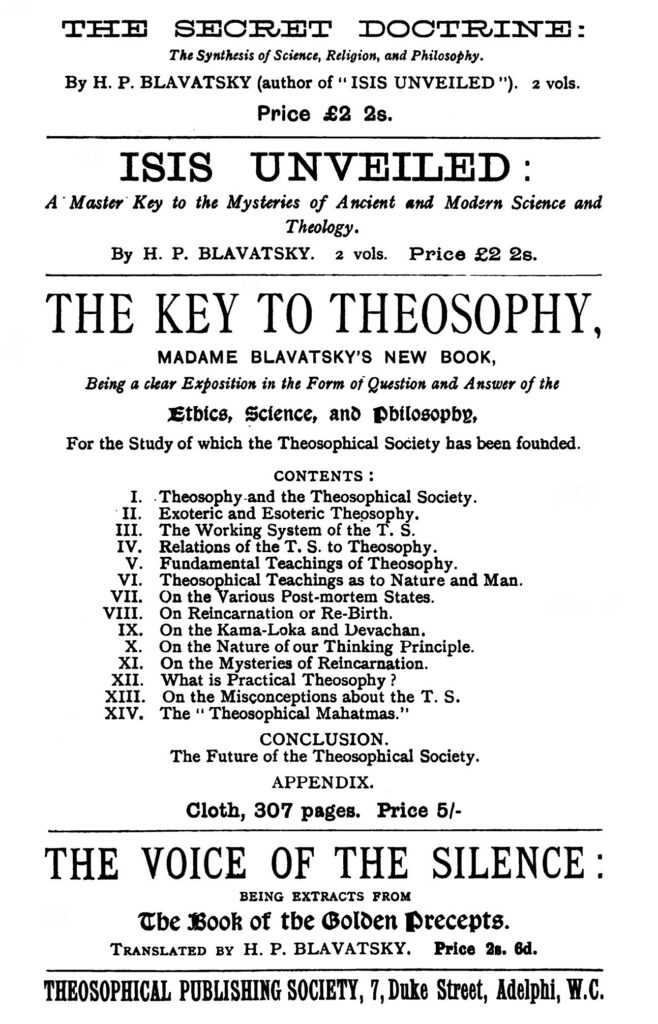
Hartmann, Franz – In the Pronaos of the Temple of Wisdom (1890)
↓ Further interesting photos from the books
↓ Traditional Theosophy before 1875
Table of books etc. mainly in English and German language
Numbers
Name, title, edition, location & year, data
Format | Topics | Digitized by; source
2010-2012 Book of Dzyan Studies. Records of Theosophy.net blog posts dedicated to the Project In Search of the Sources of the Book of Dzyan, n.p., n.d. [2014], 246 pp.
A
Name, title, edition, location & year, data
Format | Topics | Digitized by; source
Ailinger, Albert SJ – Gibt es eine Seelenwanderung? Gemeinverständliches über Theosophie und Anthroposophie. 47 pp., 1921 | 2nd rev. ed. 1952.
First as article in Deutsches Volksblatt, Stuttgart Jan., 15 1920.
article, brochure | Jesuit view on soul wandering; reincarnation, rebirth | none
Anon. – Horoskop der TG Adyar [Fragment; 1908]
paper | fragmentary horoscope | Steiner-Besant split; TS history | theoarchive; photocopied at Goetheanum
Amneus, Nils – Long-Hartley succession – Letter April 2, 1951
photocopy | leadership; successorship; Point Loma; split 1951 | theoarchive
Anon. – Das theosophische Fotoalbum Wilhelm von Hübbe-Schleidens (2020)
article | photo album of Hübbe-Schleiden in Dornach; TS history; TS Germania | Die Drei
Anon. – Flugblatt Theosophie Elberfeld (07.12.1884)
photocopy | TS Germania; TS history; probably first German flyer | theoarchive, original sold by Antiquariat Kiefer
Anon. – ‘The Coming Christ’. ‘Alcyone’s’ Father v. Annie Besant (1913), in: New Zealand Truth, Aug. 13, 1913
newspaper article | Krishnamurti; Alcyone; messiah craze; TS history | Papers past
B
Name, title, edition, location & year, data
Format | Topics | Digitized by; source
Baillie-Weaver, Harold – H. P. Blavatsky (1920), White Lotus Day, 17 pp.
brochure | memorial address | theoarchive
Bain, Alan – The Leadbeater Affair (1996)
pdf from art., circulars, letters; in html from theos-talk chats | pedo affair; TS history
Bain, Wilhelmina Sherriff – Katherine Tingley and Point Loma (1908)
pdf from art. | TS history | Papers past
Bastian, Adolf – Spiritisten und Theosophen. Deutsche Revue. Breslau, Oktober 1885 (Ackermann Katalog No. 378 (1894). Reprint attached in his work Die Seele (1886), pp. 200-221. Bastian (1826-1905) was a German physician, ethnologist, and founding director of the Museum of Ethnology in Berlin.
unknown | spiritists and theosophists | none; dilibri
Bastian, Adolf – Die Seele indischer und hellenischer Philosophie in den Gespenstern moderner Geisterseherei. Weidmannsche Buchhandlung, Berlin 1886, XLVIII, 223 pp.
Attached is his former work Spiritisten und Theosophen, pp. 200-221. Appeals to the conscience of theosophists regarding the bad consequences of their actions, since they did, after all, believe in karman (pp. 19-20). Regards the theosophists as more passive as active self-deception, who spout “empty words” (p. 20). Bastian is appalled that shoddy works like Esoteric Buddhism has already been published in its fifth edition, which he considers to be “more weeds” (p. 21 and 203).
book | spiritists and theosophists, Coulomb affair | dilibri
Becher, Theobald – Die Tattwas und ihre Bedeutung
brochure | tattvas, skandhas | none
Becher, Theobald & Holz, Gisela – Die Entwicklung der T.G. in Deutschland [1922]
Suppl. to Hartmann, Franz – Was ist Theosophie? 3. A., pp. 273-304
book | TS history in Germany | Internet Archive
Benjamin, Elsie – The Significance of the Monad Divine. Devine? Or Human? (1971)
article | human constitution | Theosophy Canada
Benjamin, Elsie – The Significance of the Seven Principles of Man (1970)
article | human constitution | Theosophy Canada
Besant, Annie – To the Members of the Theosophical Society [Leadbeater Case, 07 Sept. 1908]
circular | pedo affair; TS history | Alan Bain
Besant, Annie – Centenary Book 1847-1947 (1947), 264 p.
book | biography | TS history
Bevir, Mark – The West Turns Eastward: Madame Blavatsky and the Transformation
of the Occult Tradition (1994), in: JSTOR, Vol. 62, No. 3 (Autumn, 1994), pp. 747-767 (21 p.)
study | India, East-West, TS History | pdf to buy
Bigalke, Bernadett: Der Theosoph Hermann Rudolph: ein Lehrer aus Berufung (2009), in: Religion – Staat – Gesellschaft (1-2009) | S. 93-111 | ISSN 1438-955X, 18 pp. Abstract: “Hermann Rudolph (1865-1946), an ordinary teacher at an elementary school in Leipzig’s working class area Reudnitz, became one of the leading German theosophers for about 25 years. This article focuses on his work as a teacher by vocation in the Internationale Theosophischen Verbrüderung, an esoteric association. He shaped the profile of this umbrella association while missionizing in numerous public lectures, writing countless publications and teaching the theosophical ‘catechism’ among the theosophical adherents. In his time he represented a type of teacher that personified a highly dynamic element in the booming alternative religious and cultural milieu. The way he interlinked profession and vocation created a certain habitus (Bourdieu) which will be examined using a sociology of professions approach.”
Blavatsky, Helena Petrovna – Blavatsky Collected Writings – Vol I-XV (1874-1891), edited by Boris de Zirkoff (grand nephew)
15 vols. + cover text + common preface + (17 files) + 1 folder about changes by the editor (11 files)
Compare with the list on Blavatskyarchives of her articles, of which many are not included in the BCW.
books | first-hand Theosophy | T.P.H.
Blavatsky, Helena Petrovna – The Letters 1862-1882, vol. I and II, ed. by Alfred John Cooper (1998). The two volumes edition was his Ph.D. thesis and also the rejected version the Theosophical Publishing House (Wheaton, Illionois), who have this then only published two volumes by John Algeo (Quest Books, 2003) and John Knebel (T.P.H. 2025). There was much quarrel in theosophcial circles about the authenticity of some letters in the first volume. Cooper had planned four volumes, but his early death prevented their completion. He had known around 900 letters of Blavatsky, of which he has edit 357 letters until his death.
Blavatsky, Helena Petrovna – Letter to her aunt Nadyezhda Andreyevna de Fadeyev (July 19, 1877)
Printed in The Path 9 (Jan. 1895):301, reprints in: Theosophical Quarterly 5 (Oct. 1907): 126-35; Theosophist 53 (Oct.
1931): 32-40 and (Nov. 1931): 161-6; HPB Speaks 1:165-88 and The Letters of H. P. Blavatsky, T.P.H, Wheaton 2003, p. 314 f.
letter | Isis Unveiled, “against exact science, against Theology and for Religion” | unknown
Blavatsky, Helena Petrovna – Letter to her sister Vera [Wera] Zhelikhovskaya, Nov. 6, 1877
Photo Transcript
letter | biography | Bakhmut Roerich Society
Blavatsky, H. P. – Extract from a Letter Würzburg (24-01-1886). Extract printed as Appendix III in: Taylor, Richard P.: Blavatsky and Buddhism (1999), pp. 109-111, originally from C. Jinarajadasa, ed.: The Early Teachings of the Mahatmas, 1923.
Blavatsky, Helena Petrovna – The Key to Theosophy (1st ed. 1889)
pdf | doctrines | Internet Archive, TUP html as pdf
Blavatsky’s Family (by Blavatsky Museum) English Russian German (Google Translator)
article | Blavatsky genealogy; biography | Blavatsky Museum
Blavatsky’s Father Peter von Hahn/Petr Gan (by Blavatsky Museum)
English Russian German (Google Translator)
article | Blavatsky genealogy; biography | Blavatsky Museum
Blavatsky, Helena Petrovna – Das Lebens-Elixir. Theosophischer Verlag Paul Raatz, Berlin n. d. [1899], 112 pp. Reprinted as Pranasophia by Theosophisches Verlagshaus Hugo Vollrath, 2nd rev. and augm. ed., Leipzig 1923 XXVII, 152 pp., Foreword by Miss Gisela Holz.
Bowen, Robert – The Secret Doctrine and its Study (1891)
pdf from html | Blavatsky | Can. Theos. Association
Brailsford-Bright, J. – Theosophy and Modern Socialism (1889)
pdf from art. | Socialism | Can. Theos. Association
Bulwer-Lytton, Eduard – Margrave. Die seltsame Geschichte eines schwarzen Magiers (1913)
book | occult fiction | Internet Archive
Burrows, Herbert & Mead, G.R.S. – The Leadbeater Case
The Suppressed Speeches of Burrows and Mead (1908)
brochure | pedo affair; TS history | Alan Bain
Butler, Ronald Kenneth – The Influence of Theosophy on the Tradition of Speculative and Esoteric Theories of Music (2013)
Thesis (PhD Doctorate) | arts | Griffith Univ.
C
Name, title, edition, location & year, data
Format | Topics | Digitized by; source
Caldwell, Daniel – Theosophy – An Introduction by HPB (2012)
pdf | beginners guide | Theosophy World
Caldwell, Daniel H.: A Casebook of Encounters with the Theosophical Mahatmas (2020)
book | mahatmas, masters adepts | none
Chajes, Julie – Reincarnation in H. P. Blavatsky’s The Secret (2017)
paper | rebirth | Correspondences Journal
Cleather, Alice L. – H. P. Blavatsky, a Great Betrayal (1922)
booklet | apologetics | Internet Archive
Cleather, Alice L. – H. P. Blavatsky as I knew her (1923)
booklet | apologetics | Internet Archive
Cleather, Alice L. – H. P. Blavatsky, her Life and Work (1922)
booklet | apologetics | Internet Archive
Collins, Mabel – Das Lied von der weissen Lotos (1889)
book | mystic | none
Cooper-Oakley, Isabel – The Comte De St. Germain [1912]
book | messengers | Internet Archive
Corvinus, Leopold – Ein Gruß, ein jubelnder. Wolkenwanderer-Verlag, Leipzig 1926, 49 pp., first ed. of 255 copies. Author was US-born, who taught linguistics at the University of Berlin (Kosch, 20th century, Vol. V, 364). Grandson of Paul Raatz (1869-1939), chairman of the [first Hargrove lineage, later independent] Theosophical Society, Berlin branch.
Corvinus, Leopold – Visionen der Menschheit. Wolkenwanderer-Verlag, Leipzig 1926, 58 pp., first ed.
Coulomb, Emma – Some Account of My Intercourse with Madame Blavatsky from 1872 to 1884 (London 1885). It details Coulomb’s relationship with Blavatsky and accuses Blavatsky of faking occult phenomena. ii, 112 pp.
booklet |TS history; SPR; Coulomb conspiracy | Google
Cranston, Sylvia & Carey Williams – The Extraordinary and Influence of Life H. P. Blavatsky (3rd ed. 1994)
pen name for Anita Atkins, see Theosophy World and Theosophy Forward. TS Pasadena: “1915-2000. Author, known by her pen name Sylvia Cranston or S. L. Cranston, who wrote books on reincarnation. Anita Atkins was born on December 12, 1915, and spent her childhood and youth living in the Grand Concourse, Bronx, New York. Her formal academic education ended with high school, after which she became a self-taught scholar.”
book | biography; TS history; apologetics; Franz Hartmann; SPR; Coulomb conspiracy | Sylvia Cranston
D
Name, title, edition, location & year, data
Format | Topics | Digitized by; source
Däniken, Erich von – Die Geheimlehre der Frau Blavatsky erschütterte die Welt (1985), 1 p., in: Swiss newspaper Blick, Sept. 19, 1985.
article | Blavatsky’s Secret Doctrine, ancient manuscripts and technology, vimanas, space flights, ancient astronauts | Tatjana Ingold
Das, Bhagavan – The Central Hindu College and Mrs. Besant. The Rise of the Alcyone Cult (1913)
book | Krishnamurti, messiah craze; Alcyone | TS history | Theosophy Canada
Deinhard, Ludwig – Die ‘Theosophische Kreuzspinne’ (1891), 15 pp.
brochure | dispute within the German groups; TS history; Prof. Sellin; Hübbe-Schleiden | theoarchive; photocopied at Goetheanum
Detering, Dr. Hermann: Spuren indischer Philosophie bei Basilides – Basilides referiert Sāṃkhya (2018) Teil 1 – Teil 2
pdf | Q question, early Christianity, Christianity-Buddhism relationship, Indian influence | Radikalkritik
English translation: Detering, Hermann: Traces of Indian Philosophy in Basilides
Part 1: Basilides References to Sāmkhya (2018)
Part 2: Religious Historical Intersections (2018)
Devaranne, Theodor – Seelenwanderung und Wiederverkörperung. (Reincarnation und Karma), in: Die Okkulte Welt, Bd. 43.
Pfullingen i. Württ., Johannes Baum Verlag, (1921)
brochure | soul wandering; reincarnation; rebirth | none
Devi, Rukmini – The Artistic Side of Annie Besant (1947)
Excerpt from the Besant Centenary book
book | biography | Theosophy (Formerly theos-talk)
Dilloo-Heidger, Erik & Eike, Christine – Alois Mailänder und der Theosoph Wilhelm Hübbe-Schleiden.
Briefe, Notizen, Aufzeichnungen aus dem Hauskreis 1885 -1900 (BOD 2025).
book | biography; German TS history; | none
E
Name, title, edition, location & year, data
Format | Topics | Digitized by; source
Edge, Henry T. – Some perverted presentations of theosophy corrected. 1900s. 7 pages
brochure | TS split; Besant; Leadbeater; pedo affair | none
Einbeck, Walter – Gott, Welt und Mensch. Ihre Natur und ihre gegenseitigen Beziehungen (1922)
book | metaphysics | none
Einbeck, Walter – Zum Gedächtnis an Dr. Franz Hartmann (1838 – 1912), (1925)
booklet | biography | none
Elsas, Edeltraud, Dr. Dagmar Uecker – Stufen der Seelenentwicklung – Theosophie und Rosenkreuz im Dialog, 79 pp.
brochure | rosicrucians | none
Ervast, Pekka – Letter to Annie Besant. Published in The Theosophist 1919, vol. XL, No. 12.
letter, article | TS history | Pekka Ervast
Ervast, Pekka – Sermon on the Mount or The Key to Christianity. An Interpretation. 158 pp., T. P. H. London 1933. Translated from ancient greek into Finnish and English. Reviews in the Canadian Theosophist, vol. xiv, no. 7., Sept. 15th, 1933, pp. 214-215 and by Swami Jagadiswarananda in The Aryan Path, Vol. 4, 1933, October, p. 708.
brochure | gospels, bible | none
Ervast, Pekka – Esoteric Teachings [Finnish, not available in English]. Helsinki: Literary Society of the Finnish Rosy Cross, 2005.
brochure | esotericism | none
Ervast, Pekka – Exoteric and Esoteric Theosophy [Finnish, not available in English]. Vilppula: Ihmisyyden tunnustajat, 2011.
brochure | esotericism | none
Ervast, Pekka – Die Botschaft der Theosophie für die heutige Zeit. In Fragen und Antworten (2012), 99 pp. German translation of the Finnish original “Teosofian sanoma nykyajalle” (Tampere 1919)
brochure | TS in Finland | unknown
Ervast, Pekka – Kleiner Rosenkreuz-Katechismus. German translation. 43 pp. Väinöla, Vilppula, n. d.
brochure | rosicrucians | Pekka Ervast
F
Name, title, edition, location & year, data
Format | Topics | Digitized by; source
Fährmann, Johannes (pen name of Fändrich, Hans, as well as Oscar Steinbach as Fändrich’s second pen name)
Fährmann, Johannes – Die Geistesströmungen unserer Zeit. Leipzig: A. Frankes Verlag, 1904. 169 pp.
Fährmann, Johannes – Verbrechen und Todesstrafe. Eine philosophische Betrachtung, Leipzig: A. Frankes Verlag, 1904, 33, 4 pp. (sequential numbering of the series [5], 70-100, [4]. Series Wichtige Zeit- und Lebensfragen.
Fährmann, Johannes – Nach Nirwana auf achtfachem Pfade. Der Weg zur Vollkommenheit. Leipzig und Frankfurt a. M.: Jaegerersche Verlagsbuchandlung, [c. 1905], 124 pp.
Fährmann, Johannes – Die Lehre von der Wiederverkörperung des Menschen. Dargestellt nach der indo-arischen Geheimlehre (1930). Series: Bücher aus der Schatzkammer des Wissens und des Glaubens. Buenos Aires: Schatzkammerverlag Hans Fändrich, 1954, 100 pp.; 2nd, augmended ed., Calw (Württ.) n. d., 3rd ed. 1992, 96 pp.
Fährmann, Johannes – Die Lehre von der Periodischen Wiederkehr im Kosmos. Dargestellt nach der indo-arischen Geheimlehre. Series: Grosser theosophischer Katechismus, part V, Buenos Aires: Schatzkammerverlag, 1954, 95 pp.
Fändrich, Hans – Der Anbruch eines neuen Zeitalters, die kommende neue Weltreligion der Bruderschaft und ihr Vorläufer, die Theosophische Verbrüderung. Series: Schriften des Aufklärungs- und Werbedienstes für die theosophische Weltanschauung, No. 1; contains two articles:
1. Fährmann, Johannes (pen name of Fändrich) – Der Zusammenbruch unserer Kultur und Zivilisation
2. Rudolph, Hermann – Bruderschaft, das Sittengesetz des neuen Zeitalters
Buenos Aires, Verlag der “Schatzkammer” Hans Fändrich, n. d. [c. 1950], 24 pp.
brochure | new age, coming new world religion | none
Fändrich, Hans – Ausgewählte theosophische Literatur, Schatzkammer-Verlag Hans Fändrich. – With articles of Johannes Fährmann (pen name of Fändrich), Franz Hartmann, Hermann Rudolph, Helena Petrovna Blavatsky etc., Calw-Hirsau .n. d. [c. 1970], 24 pp.
Fechner, Gustav Theodor – Das Büchlein vom Leben nach dem Tode (1835, ed. 1947), ed. 1947 55 pp.
booklet | life after death | unknown
Fergus, John W. – Stanzas of Dzyan – Critical Edition (2022)
pdf draft | The Book of Dzyan; The Secret Doctrine | Universal Theosophy
Fischer, Dr. Bernard: Grundzüge der Philosophie und der Theosophie populär und für gebildete Leser leicht fasslich dargestellt. Kommissions-Verlag von M. Schäfer, Leipzig 1899, VII, 220 pp. Dr. Bernard (also Bernhard) Fischer (born January 12, 1821, in Budikau, died June 17, 1906, in Leipzig, was a Bohemian rabbi and publicist (Wikipedia).
book | basic outlines of philosophy and theosophy | none
Fischer, Dr. Hermann Rudolph – Was haben Naturwissenschaften mit Religion zu tun? Series: Weltgesetz und Weltanschauung, No. 1. Calw-Württ., Schatzkammerverlag Hans Fändrich 1962, 15 pp. Fischer is the son of Hermann Rudolph, der president of the I.T.V. Fischer studied geography as an unpolitical subject instead of religion or philosophy to avoid conflicts (oral information to us).
brochure | universal laws, natural sciences and religion | none
Fischer, Dr. Hermann Rudolph – Gottesbegriff und Atomphysik (Das Weltgesetz der Unität). Series: Weltgesetz und Weltanschauung, No. 2. Calw-Württ., Schatzkammerverlag Hans Fändrich 1962, 13 pp.
brochure | universal laws, concept of God, atomic physics | none
Fischer, Dr. Hermann Rudolph – Die Erhaltung allen Daseins und drei weitere Aufsätze. Series: Taschenbücher für die Darstellung der theosophischen Weltanschauung und verwandter Geistesrichtungen, No. 6. Munich, Schatzkammer-Verlag 1983, 73 pp.
brochure | universal laws, existence | none
Frater Apollonius – The Annotated Book of Dzyan (2011)
pdf | The Book of Dzyan; The Secret Doctrine | Archidox
Friedrich, Wilhelm – Über Lessings Lehre von der Seelenwanderung. Preisgekrönt von der August Jenny-Stiftung. 114 pp., Oswald Mutze, Leipzig, 1890
brochure | soul wandering; Lessing; reincarnation; rebirth | none
Fullerton, Alexander – Letter extracts to Marie B. Russak (1907)
letter extract | succession Besant-Olcott; Leadbeater pedo affair | Alan Bain
Fussell, Joseph H. – Incidents in the History of The Theosophical Movement (1920 3rd rev. ed.)
Fussell, Joseph H. – Ereignisse in der Geschichte der Theosophischen Bewegung (German translation)
brochure | TS history; affairs; split 1895; Coulomb, Fullerton | Internet Archive
Fussell, Joseph H. – Mrs. Besant and the Leadbeater Advice [1913]
brochure | pedo affair | Internet Archive
Fussell, Joseph H. – Mrs. Annie Besant and the Moral Code. A Protest (1909)
brochure | pedo affair | Internet Archive
Fussell, Joseph H. – Some Reasons Why the Members of the Universal Brotherhood and Theosophical Society
Do Not Endorse Mrs Besant Nor the Society of Which She is President (1913)
brochure | pedo affair | none
Fussell, Joseph H. – Something the Public Should Know (1910)
Fussell, Joseph H. – Etwas, das die Öffentlichkeit wissen sollte (n.d. c. 1910) (German translation), 4 pp.
flyer | pedo affair; Leadbeater; Besant; Fullerton; TS history | none, German: theoarchive
Fussell, Joseph H. – William Kingsland – An Open Letter to Annie Besant
flyer | pedo affair; Leadbeater; Besant; TS history | none
Fussell, Joseph H. – Mrs. Besant’s Policy. “San Diego News” Press, 1914. 22 pages.
flyer | pedo affair; Leadbeater; Besant; TS history | none
Fussell, Joseph H. – More Light – A Study of Theosophy and Freemasonry
article | Freemasonry | none
G
Name, title, edition, location & year, data
Format | Topics | Digitized by; source
Geering, Rudolf – Einladung Hauptversammlung D.T.G. (1895)
circular | invitation general meeting at Febr. 17, 1895; TS history in Germany | theoarchive, photocopied at Goetheanum
Geppert, Alexander C.T., Andrea B. Braidt (Hg.) – Orte des Okkulten (2003)
studies; booklet | occult & TS history in Germany | Univ. of Berlin
Glückselig [d.i. Gottfried Buchner] – Der Tod. Ein Evangelium des Lebens. Verlag von Karl Rohm, Amden (Schweiz) n. d. [1901], 24 pp. Series: Bibliothek der Lebens-Spuren No. 1 / Sonderdruck aus der Zeitschrift “Lebens-Spuren”). 2nd. ed. by Johannes Landenberger, 1910, 23 pp. – “Die Gedanken dieses Büchleins sind aus der Tiefe reiner Wahrheitserkenntnis geflossen und spiegeln in knappen Umrissen eine mit der Bibel im Einklang stehende theosophische Weltanschauung wieder.” (Foreword of the editor in the 2nd ed.)
Göring, Hugo – Dr. Franz Hartmann, ein Vorkämpfer der Theosophie (1896, Transcript), (1896, scan)
booklet | biography | unknown
Göthke, Albert – Mein Traum vom goldenen Apfel und Wunder-Ei. Eine Weihnachtsgeschichte von den Mammrähnen aus dem Feenlande. Erzählung für die gereiftere Jugend. Berlin, Theosophisch-kommunistische Loge Oschm-Rahmah-Johjihjah, 2nd. ed. 1906, 84 pp.
Gomperz, Heinrich: Die indische Theosophie vom geschichtlichen Standpunkt gemeinverständlich dargestellt. Diederichs, Jena 1925, 450 pp.
Gomperz (1873–1942) was a lecturer at the University of Vienna from 1905 and a full professor from 1924.
„From lectures I gave on the history of Indian philosophy at the University of Vienna in 1908/09 and 1917/18, 30 popular university lectures on the same subject emerged, which I also gave in Vienna in 1919/20 and which were recorded in shorthand. It is the revised version of these notes that I hereby present to all Germans who may be interested in them. I use the word “theosophy” in the same sense as Oltramare in his Histoire des idées théosophiques dans l’Inde (Paris, 1906) and Speyer in his Indische Theosophie, aus den Quellen dargestellt (Leipzig 1914) to describe Indian views, intuitions and insights into the divine, while I would understand Indian philosophy in the sense of Suali in his ‘Introduzione allo studio della filosofia Indiana’ (Pavia 1913) to mean only those trains of thought characteristic of the Indian Middle Ages that developed into a scientific system“ (Preface p. 3)
book | mostly about brahmanism, yoga, Jainas, Nagajurna, sankhya, vedanta | none
Greusel, John Hubert – Katherine Tingley, humanity’s friend (1907)
booklet | TS history | Internet Archive
Gruffman, Paulina – The Quest for Gnosis. G. R. S. Mead’s Conception of Theosophy (2020)
study | gnosis, early Christians | Univ. of Stockholm
Gruffman, Paulina: The Relationship Between the Theosophical Society and Western Esotericism. Paper presented at the International Theosophical History Conference, 8 October 2021.
Abstract: Since its inception, scholars in the field of Western esotericism have counted the Theosophical Society among its subjects of study (Faivre 1994). Given the fact that there are several competing ways of conceptualizing esotericism today, the question of whether and/or how the Theosophical Society fits within the category has no easy answer.
This paper will consider whether and how the Theosophical Society can be conceived of as an esoteric group from several standpoints in regards to different understandings of esotericism. Drawing on recent debates within the field of (Western) esotericism, as well as studies on until recently neglected aspects of the Theosophical Society during the late nineteenth and early twentieth century (such as its function as a global society, debates and differences within the organization as well as focus on individuals who have not made it into the standard canon of Theosophical history, such as G.R.S. Mead), I aim to give a nuanced and complex account of how we can best conceive of the Theosophical Society today prior to and after the passing of H.P. Blavatsky.
Live recorded presentation on YouTube: https://youtu.be/xWsQzJ-nep4
lecture, video | TS history, esotericism | Academia
Guignette, Jean-Paul – Bibliography of H. P. Blavatsky (1987)
brochure | bibliography | theohistory
Günzl, Josef: Auf sonniger Höh’! Gedichte theosophischen und belletristischen Inhalts. Edition and foreword by Leopold Engel.
Josef Günzl (1841–?), founder of the Vienna Theosophical Society.
Bitterfeld: Baumann-Verlag 1899, XIV, 254 pp.
book | poems | none
H
Name, title, edition, location & year, data
Format | Topics | Digitized by; source
Hammer, Walter (pen-name of Walter Hösterey) – Die Generalanzeiger-Presse kritisch beurteilt als ein Herd der Korruption. 55 p., Theosophisches Verlagshaus, Leipzig, Hugo Vollrath, 1st and 2nd. ed. 1911; 4th ed. 1912, 56 p. Publisher of the Jugendbewegung. Biographies: 1. dissertation of Jürgen Kolk (2010), 2. Axel Flake/Heiko Schmidt:
“Der in Elberfeld geborene Verleger und Publizist Walter Hammer (1888-1966). Ein Beitrag zu Jugendbewegung, Pazifismus und Widerstand.” 3. Walter Hammer und Erna Hammer-Hösterey: “Die bleibende Spur: Ein Gedenkbuch für Walter Hammer. 1888 – 1966”, Hamburg: Janssen, 1967, 296 S.
brochure | corruption in the press | none
Hanegraaff, Wouter – The Theosophical Imagination (2017)
article | clairvoance; Leadbeater; psychometry; astral world | Correspondences Journal
Harlass, Ulrich – Die orientalische Wende der Theosophischen Gesellschaft. Eine Untersuchung der theosophischen Lehrentwicklungen in der Zeit zwischen den Hauptwerken Alfred Percy Sinnetts (2021) [publisher ad only]
book | doctrines; study | pdf to buy
Harris, Iverson L. – Helena Petrovna Blavatsky – A refutation of slanders against the foundress of the Theosophical Society (1921)
Professor of law, the Theosophical University. Student under Katherine Tingley, Leader and Official Head of the Universal Brotherhood and Theosophical Society and successor to H. P. Blavatsky and William Q. Judge. Reprint in: Tingley, Katherine – Helena Petrowna Blavatsky (1921), pp. 15-21.
brochure | apologetics, biography | none
Harris, Iverson L. Jr. – Katherine Tingley’s Raja-Yoga System of Education [1922]
brochure | school reform, spiritual education, Point Loma | Internet Archive
Harte, Richard – Introduction to ‘Keely’s Secrets’ (1888)
pdf from html | technology; Bloomfield Moore | Can. Theos. Association
Harte, Richard – The Hebrew Talisman (1888, scan)
html | pdf backup of htm | bio of Harte
booklet | banking system | Internet Archive, Theosophy Canada
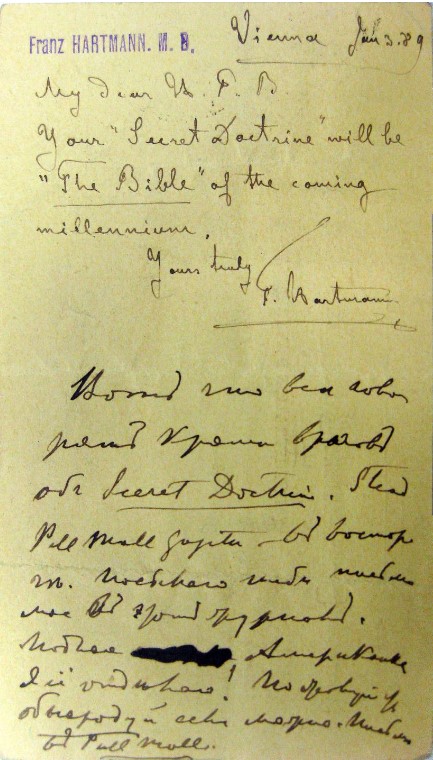
Hartmann, Franz – Postcard to Blavatsky, Jan. 03, 1889 from Vienna to London
“My dear H. P. B. Your “Secret Doctrine” will be “The Bible” of the coming millenium.
Yours truly, F. Hartmann”
postcard | The Secret Doctrine | Bakhmut Roerich Society
Hartmann, Franz (Transl.) – Atma Bodha
(Selbsterkenntnis) (1895)
book | self-knowledge | none
Hartmann, Franz – Sozialismus und Theosophie (1898)
article; brochure | socialism | Theosophische Informationsstelle
Hartmann, Franz – Autobiography (Occult Review Jan. 1908)
article | biography | Internet Archive
Hartmann, Franz – In the pronaos of the temple of wisdom (1st. ed. London 1890)
Ad title in The Key to Theosophy, 1889: “Gossip about the true & false Rosicrucians and the Fire Philosophers”
1st. US ed. Boston 1890
book | traditional theosophy; Hermetism | Internet Archive
Hartmann, Franz – Magic, Black and White (5th ed., London 1904)
Hartmann, Franz – Magic, Black and White (8th Am. Ed. rev., Philadelphia 1904)
book | doctrines | Blavatsky Archives, Internet Archive
Hartmann, Franz – Ueber Eine neue Heilmethode zur Heilung von Lungentuberkulose, Katarrh, Influenza und anderen Krankheiten der Atmungsorgane vermittelst der Einathmung gewisser Gase und Dämpfe aus der bei der Cellulosefabrikation gebrauchten Kochflüssigkeit. Nebst einem Anhange, bezugnehmend auf verschiedene noch wenig erforschte, aber im Alterthum wohlbekannte Entstehungsursachen von Krankheitserscheinungen.
Leipzig, Verlag von Wilhelm Friedrich n.d. [c. 1905], 40 pp. The publisher’s stock was later bought up and distributed by Hugo Vollrath, Theosophisches Verlagshaus, who covered the publisher’s imprint with a sticker.
brochure | healing by inhale lignulsulfit | none
Hartmann, Franz – Betrachtungen über die Mystik in Goethes “Faust”. Leipzig, Verlag von Wilhelm Friedrich n.d. [1900], iv, 152 pp. First publication in an article series in his Lotusblüthen as „Über die esoterische Bedeutung einiger Stellen aus Goethes ‚Faust‘“ in six parts from July 1899 to December 1899. Some copies have the sticker of the new publisher “Theosophische Central-Buchhandlung”. Reprint as Die Mystik in Goethes Faust. Eine Betrachtung, by Theosophisches Verlagshaus Hugo Vollrath n. d. [c. 1921 as issue 5/6 of vol. x Hugo Vollrath’s magazine is mentioned in the new foreword by Miss Gisela Holz, and which run started in 1910], 172 pp.
brochure | esoteric interpretation of Goethe’s “Faust” | none; Herzogin Anna Amalia Bibliothek
Hartmann, Franz – Pansophia (1924)
book | Rosicrucians | Internet Archive
Hartmann, Franz – Populäre Vorträge über Geheimwissenschaft, Band 2 (1900)
book | articles collection | none
Hartmann, Franz – Was ist Theosophie 3. A. [1922]
Collection of his former articles and lectures (with changes) and supplement of the TS history, see Becher, Th.
book | articles collection; TS history in Germany | Internet Archive
Head. Joseph & Cranston, Sylvia – Reincarnation; an East-West anthology
including quotations from the world’s religions & from over 400 Western thinkers (1961)
book | rebirth | Internet Archive
Hess, Karolina Maria – The Beginnings of Theosophy in Poland (2015)
study | TS history in Poland | ResearchGate
Hoffmann, Baron Oskar von – Letter to Alfonso – [About his visit to Blavatsky in Elberfeld] (17. Sept. 1884, fragmentary, Limburg version)
letter; partial, transcript via Horst E. Miers | Blavatsky in Elberfeld; TS Germania; TS history in Germany | theoarchive
Hoffmann, Baron Oskar von – Letter to Alfonso – [About his visit to Blavatsky in Elberfeld] (17. Sept. 1884, fragmentary, Dornach version)
letter; partial, variant transcript | Blavatsky in Elberfeld; TS Germania; TS history in Germany | theoarchive; photocopied at Goetheanum
Holzweber, Brigitte – Die okkulten Wege der Wiener Moderne. Eine religionswissenschaftliche Analyse der „Wiener Rundschau“
book | master’s thesis; Vienna; Franz Hartmann; Rudolf Steiner; Friedrich Eckstein | Univ. of Vienna
Hübbe-Schleiden, Wilhelm – Letter to Seiler (March 1, 1894)
letter | TS Theosophische Vereinigung, successor of TS Germania, precursor of Adyar section; TS history in Germany | theoarchive photocopied at Goetheanum
I+J
Name, title, edition, location & year, data
Format | Topics | Digitized by; source
Jeremias, Alfred – Buddhistische und theosophische Frömmigkeit. Mit einer zusammenfassenden Einleitung über das Wesen der Frömmigkeit und über das Verhältnis der Religion zur christlichen Frömmigkeit (1927), 44 p.
J. was a professor of theology at the University of Leipzig, which became in 1912 the first German university with a chair of comparative religious science. He is said to have planned the world-wide first chair for Theosophy (sic) at the department of philosophy, but political developments prevented it. (oral information by Hermann Rudolph-Fischer, son and after-war succeccor as head of the Hartmann TS ITV, which existed for 40 years from 1897-1937, when they were forbidden). Reviews: 1. by Richard Karutz in: Die Drei, 1927; 2. J. Lippl in Theologische Revue; 27(1928), 11, Seite 398-399; 3. N. Schlögl, in: Wiener Zeitschrift für die Kunde des Morgenlandes, 1929, Vol.36 (1), p.150.
brochure | buddhistic and theosophistic piety | Staatsbibliothek zu Berlin
Jinarajadasa, C. – The Golden Book of the Theosophical Society (1925)
Compiled by us into one large file compressed in 71 MB and original in 755 MB
book | TS history | Theosophy World
Judge, Rajbir Singh – Dusky Countenances – Ambivalent Bodies and Desires in the TS (2021)
pdf | TS history; Esoteric Section; sex problems | Rajbir Judge
K
Name, title, edition, location & year, data
Format | Topics | Digitized by; source
Kaiser, Tomas – Zwischen Philosophie und Spiritismus (2006)
study | Carl du Prel; TS Germania; TS history in Germany | Univ. of Lüneburg
Kämpfer, Friedrich – Der Tod… und was dann? [1915] p. 47 is missing.
Review in “Das literarische Echo”, 22. Jg., Oct. 1919 – Oct. 1920, p. 930. (table of contents only)
brochure | death, reincarnation | theoarchive
Kamensky, Margarete – Eine historische Skizze des Buddhismus auf esoterischer Grundlage. “Kschatriya”-Verlag Margarete Kamensky, Weimar n. d. [1921], 78 pp.
Kamensky, Margarete – Das Buch des kommenden Tages. Theosophisches Verlagshaus Leipzig n. d. [1921]., 219 pp. Quotation: “In diesem Buche, in dem der erste Teil der Gegenwart und der zweite den kommenden Jahrhunderten geweiht ist, wollen wir versuchen, unser jetziges Leben, im Stadium des Absterbens unseres göttlichen Wesens zu skizzieren und zu zeigen, was es einmal sein würde, wenn dieses Wesen erkannt, erforscht und ebenso planmäßig und sorgfältig gepflegt würde, wie heute die Übung des Leibes und die Entwicklung des Gehirns betrieben wird.” (p. 15) – Contents: Die heutige Schule; Nation u. Nationalismus; Von den gottesschänderischen Jahrhunderten zu denen des Gleichgewichts; Die Erziehung in den kommenden Jh.; Das Äussere der Stadt in den kommenden Jh.; Die Sendung des Einzelmenschen; Unterweisung in der Pflanzenkunde; Vergleichende Unterweisung in den Religionen; Unterweisung in der Seelenkunde.
Kerning, Johann B. – Weisheit der Orients. Ediert von Franz Hartmann (1901) Pen name for Johann Baptist Krebs
book | mystic, wisdom | Internet Archive
Kirsebom, Klara – Letter to Emmi Haerter, Gelsenkirchen Lodge, May 1, 1951
letter | leadership; successorship; Point Loma; split 1951 | theoarchive
Klatt, Norbert – n. n. [a criticism of the Mahatma Letters]. He has viewed them in an unknown theological journal at first as forgeries, but after his research of the Hübbe-Schleiden estate he changed his view and didn’t want his paper to be circulated anymore (oral information from him to us), ca. 1992.
paper | Mahatma Letters | higher beings | none
Klatt, Norbert – Theosophie und Anthroposophie. Neue Aspekte zu ihrer Geschichte aus dem Nachlaß von Wilhelm Hübbe-Schleiden (1846-1916) mit einer Auswahl von 81 Briefen (1993). Review: Die Drei, 7, 1995.
Kalliope-Verbund: “… die von Norbert Klatt nicht ermittelten Briefe Alois Mailänders befinden sich im Rudolf Steiner Archiv in Dornach im Nachlass von Emil Bock; freundlicher Hinweis von Dr. Martina Maria Sam, Nov. 2021.”
book; find book | TS Germania; TS history in Germany | none
Klatt, Norbert – Der Nachlass von Wilhelm Hübbe-Schleiden in der Niedersächsischen Staats- und Universitätsbibliothek Göttingen. Verzeichnis der Materialien und Korrespondenten (1996)
book; find book | TS Germania; TS history in Germany | none
Klatt, Norbert – Wilhelm Hübbe-Schleiden – Indisches Tagebuch. 1894/1896. Mit Anmerkungen und einer Einleitung herausgegeben von Norbert Klatt. Göttingen 2009.
book | travel diary; India; Adyar; TS history in Germany | Norbert Klatt
L
Name, title, edition, location & year, data
Format | Topics | Digitized by; source
Lamprecht, Dr. Harald – Überblick über die Geschichte der Theosophischen Gesellschaften in Deutschland
article | TS history in Germany | Neue Rosenkreuzer
Laun, Friedrich – Moderne Theosophie und katholisches Christentum (2. ed., 1922), 44 p. Quote p. 42:
“… [E]in überzeugter Katholik, der zugleich ein wissendes Mitglied der theosophischen oder anthroposophischen Gesellschaft wäre, ist so unmöglich wie ein Lamm in Gesellschaft der Füchse, ein Theosoph in katholischer Gesellschaft vielleicht ein Fuchs im Schafskleid.”
brochure | Catholic view on theosophy | none
Laur, Dr. Peter – Ein deutschbaltischer Hintergrund der ‘Theosophie’? (2006)
Review: Reitemeyer, Frank – Open Questions in H. P. Blavatsky’s Genealogy, in: Fohat, summer 2006
article | Blavatsky genealogy, ancestors | theoarchive
Lavoie, Jeffrey – Saving Time. Time, Sources, and Implications of Temporality
in the Writings of H. P. Blavatsky (2015)
theses | chronology, darwinism; geological ages | Core
Leadbeater, Charles W. – An Occult View of the War (1916)
Cp. Dr. Rudolf Steiner’s occult views on WWI, who came to quite opposite results as well as Katherine Tingley. Recent historical research confirms Steiner and Tingley (Sir Christopher Clark: Sleepwalkers).
brochure | World War I | Anand Gholap
Lechner, Gerhard – Der theosophische Einfluss auf Rudolf Steiners fünftes Evangelium (2024), 18 pp.
Leese, Kurt – Moderne Theosophie (2nd ed. 1921)
book | Protestant view on theosophy | Internet Archive
Levy, Eugene – Mrs Besant and the Present Crisis in The Theosophical Society (1913)
book | Krishnamurti; Alcyone; messiah craze; TS history | Internet Archive
Lindtner, Dr. Christian: Geheimnisse um Jesus Christus (Süderbrarup 2005, 396 p.). Website: jesusisbuddha. The publisher ad flyer.
book | Q question, early Christianity, Christianity-Buddhism relationship, Indian influence, Buddhism in Europe | none
Lindtner, Dr. Christian – More Than 500 Witnesses – All False – Buddhist Sources (2009)
Reprint from Lockwood, Dr. Michael – Buddhism’s Relation to Christianity (2010-2015), pp. 278-79.
article | Buddhism, Christianity, Q question | Adyar News Bulletin (scholarly)
Lindtner, Dr. Christian – 500 Brothers Alexandrian Crypto-Buddhism… MORE THAN 500 BOUTTA WITNESSES… (Århus handout 2015), 2 p.
Handout | Q question, early Christianity, Christianity-Buddhism relationship, Indian influence, Buddhism in Europe | jesusisbuddha
Lobanova, Marina: Mystiker, Magier, Theosoph, Theurg: Alexander Skrjabin und seine Zeit. Hamburg: von Bockel 2004. 364 p. : Ill., Noten.
book | music, arts | none
Lockwood, Dr. Michael – Buddhism’s Relation to Christianity (2010-2015)
book | Buddhism, Christianity, Q question | Academia
Lockwood, Dr. Michael – Dr. Christian Lindtner and Gematria-Isopsephy (2021)
pdf | Buddhism in Europe, pre-christian | jesusisbuddha
M
Marfels, Wilfried – Kleine Einführung in die Theosophie, n. d. [1986]
brochure | introduction | theoarchive
Martens, Peter Christoph – Am Lebenswege (Theosophisches Brevier)
Bitterfeld: Verlag von F. E. Baumann, c. 1900
unknown | mystic, right living | none
Marvell, Leon – The Imaginal Realm and the Hermetic Foundations of Science (2016, Crotona Verlag)
Marvell, Leon – Einheit. Die hermetischen Grundlagen der Wissenschaft (2018, Crotona Verlag)
book | gnosis | none
M., V. – The strange little girl, a story for children [c. 1911]
booklet | children | Internet Archive
Mead, G.R.S. – Fragments of a Faith Forgotten (1900)
book | gnosis; pistis sophia | Bahai
Mead, G. R. S. – Pistis Sophia (1896)
Mead, G. R. S. – Pistis Sophia (rev. ed. 1921)
book | gnosis; pistis sophia | Internet Archive
Mead, G. R. S. et. al. – The Leadbeater Case. Reply to the President’s Letter (1908)
circular | pedo affair; TS history; | Alan Bain
N
Name, title, edition, location & year, data
Format | Topics | Digitized by; source
Nair, Taravath Madhavan – The Evolution of Mrs. Besant (1918) Pen name “The editor of “Justice”, Madras”
book | Krishnamurti; Alcyone; messiah craze; TS history; Judge; pedo affair; Leadbeater; letters from Mrs. Dennis etc. | Internet Archive
O
Name, title, edition, location & year, data
Format | Topics | Digitized by; source
Oberth, Hermann – Ist Jenseitsforschung überhaupt möglich? 39,5 pp. manuscript fragment, intended as part 1 of a projected series “Träger des Lebens. Schriftenreihe über Seele, Theosophie und Okkultismus“. Dealer offer.
unfinshed, unpublished manuscript | the beyond; theosophy; soul; rocket science, Wernher von Braun, Peenemünde | none
Olcott, Henry S. – Inaugural Address (1875)
lecture | TS launch | Isis invokes
Olcott, Henry S. – The Count de Saint-Germain and H. P. Blavatsky – Two Messengers of the White Lodge (1905-1918)
pdf from html | messengers | Can. Theos. Association
O.S.T. [Östliche Schule der Theosophie] Lieder. Eigentum der O.S.T. Privat, streng vertraulich! Schreibmaschinen-Manuskript (tlw. als Durchschlag o. hektografiert),
[O.S.T. [Eastern School of Theosophy] Songs. Property of the O.S.T. Private, strictly confidential! Typewritten manuscript (partly as carbon copies or hectographed)], 44 pp. Contains 45 song lyrics.
The O.S.T. regarded herself as “the outermost ‘aura’ of the Masters of the ‘White Lodge’ in the material world” (p. 65). The school had only few members, a fact attested to by the method used to reproduce the present text. An Esoteric Circle was also established within the O.S.T. on October 12, 1925 (which E.S. manuscripts in the theoarchvies which will we publish asap). Only 17 members attended the inaugural meeting. In total, only 21 individuals had registered with Raatz for it (regarding Raatz, cf. Lechler I; and Helmut Zander: Anthroposophie in Deutschland, Vol. 1).
P
Name, title, edition, location & year, data
Format | Topics | Digitized by; source
Pelletier, Ernest – The Judge Case Vol. 1+2 (2004)
book | Judge case; split 1895; successorship | Theosophy Canada
Pelletier, Ernest – Annie Besant, Theosophy and the Liberal-Catholic Church (2013)
book | Leadbeater affair; TS history; LCC | Theosophy Canada
Penzig, Prof. Dr. Otto – Die Theosophie und die Theosophische Gesellschaft (1921)
book | TS history | Warburg Institute, TIB
Point Loma daily time schedule (1909)
pdf from flyers | Sightseeing ad for Lomaland; TS history | UC San Diego
Price, Leslie – Madame Blavatsky, Buddhism and Tibet (2005). A Spoken Paper at the Theosophical History Conference, London, Sunday 15 June 2003, with revisions.
lecture | TS history, Masters, Buddhism, Tibet | Blavatsky Archives
Priem, Georg – Franz Hartmann, sein Leben und Wirken. Eine Gedenkschrift zur Erinnerung an den Gründer der Internationalen Theosophischen Verbrüderung (1912)
booklet | TS history; ITV; biography | none
Pryse, James M. – An Important Statement [on SD vols. III+IV] (1926)
article | missing SD volumes; | IAPSOP
Pryse, James Morgan – The restored New Testament I (1914)
Pryse, James Morgan – The restored New Testament I (4th ed.)
Pryse, James Morgan – The restored New Testament I (1914, OCR)
Pryse, James Morgan – Reinkarnation im Neuen Testament (German translation), Ansata, Interlaken, 1980, 1981, 2nd corrected ed. with comments by Agnes Klein 1982, 3rd corrected ed. with index 1995, all ed. with 156 pp.
Theosophy Wiki
books | Holy Bible; gospels; forgery; Early Christianity; | Internet Archive
Pryse, James Morgan – The restored New Testament II (1925)
book | Holy Bible; gospels; forgery; primordial Christianity; | none
Purucker, Gottfried von – Blavatskys wissenschaftliche Vorwegnahmen (1927)
quote | science; Blavatsky’s scientific anticipations | theoarchive
Q+R
Name, title, edition, location & year, data
Format | Topics | Digitized by; source
Raatz, Paul – Letter to Seiler (Dec., 09 1893), (fragment), 4 pp. + 1 front page with archive note. Raatz lived 1869-1939.
letter | TS history in Germany | theoarchive, photocopied at Goetheanum
Raghunathan, Radha – Dr. Christian Lindtner’s Aggersborg Tantram – Obituary (2021)
article | Buddhism in Europe, pre-christian | jesusisbuddha
Ragon, Jean-Marie – Die Messe in ihren Beziehungen zu den Mysterien und Zeremonien des Altertums (1908)
in: Neue Metaphysische Rundschau; XV. Jg. 1908 in two parts: 1. pp. 27-34, 2. 136-142; 15 pp. +1 publishing ad.
article | secrets of masses, masonry, esoteric Christianity | theoarchive
Reigle, Nancy & David – The Lost Kalacakra Mula Tantra (1986)
brochure | Book of Dzyan | Academia
Reigle, David – Curriculum in the Wisdom Tradition (2005)
pdf | Sanskrit; Patanjali, Blavatsky | Eastern Tradition
Reigle, David – The Book of Dzyan – The Current State of the Evidence (2013)
brochure | Book of Dzyan | Academia
Reitemeyer, Frank – Franz Hartmann im Kreuzfeuer. Neusprech auf dem Vormarsch? (2000)
brochure | translation issues; Secret Doctrine | theoarchive
Rembe, Anatole – Christus der Mensch und Freiheitskämpfer, Wilhelm Friedrich, Leipzig 1887, 80 pp.
Probably Rembe’s Christian world view before he became a theosophist
brochure | Christ | none
Rembe, Anatole – Der Weg zum wahren Erfolg, n.d. (c. 1920), 68 pp.
brochure | transformation to the higher with theosophical doctrines | theoarchive
Rembe, Anatole – Giordano Bruno (1929)
brochure | inquisition, persecution | theoarchive
Report of the T.S. In Finland 1.11.1913-31.10.1914
brochure | TS Finland, TS history | Pekka Ervast
Riedlin, Dr. med. Gustav – Der Vegetarismus im Lichte der Theosophie
broschure | vegetarism | none
Riley, Rev. William Bell – Theosophy, Or, Buddhism Abroad, 1899, Christian Alliance Publishing Co., 27 pp.
P. 27: Theosophy says, “Be good, do your best, and in seventy millions of years Jesus Christ says, “Believe on Me, and today thou shalt be saved.” No matter about the past. No matter about the future. The past will be forgiven. The future will be cared for by the power of God. The sins that have beset you until now shall be swept out of your lives; the sorrows that have come in consequence shall be taken away and you
shall be saved.”
broschure | Christian apology | Google
Rohm, Karl – Urteile von Kirchenvätern über den Vegetarimus. Stuttgart: Karl Rohm Verlag, c. 1900
flyer | vegetarism | none
Rohm, Karl – Der Vegetarismus im christlichen Mönchtum. Stuttgart: Karl Rohm Verlag, c. 1900
flyer | vegetarism | none
Rohm, Karl – Erfahrungen eines jungen Vegetarieres. Stuttgart, c. 1900
flyer | vegetarism | none
Ross, Lydia and Ryan, Charles J. – Theosophia: An Introduction, revised and edited by Helen Todd and W. Emmett Small (Point Loma Publications, San Diego 1974).
brochure | introduction | none
Ross, Joseph E.
– C. W. Leadbeater Unveiled. Rustling Shadows (2021)
Supplement to Krotona of Old Hollywood, Volume I (2021)
book | Leadbeater affair; TS history; Krishnamurti | Krotona Archive
– Krotona Institute of Theosophy (2021)
booklet | TS history, Krishnamurti | Krotona Archive
Row, Subba – Collection of Esoteric Writings (1910)
book | doctrines | Internet Archive
Rudolph, Hermann
– Unser Sonnensystem (n. d. [1906])
broschure | solar system, cosmos | theoarchive
– Die Stufen des inneren Lebens, n.d. [c.1914], 6 pp.
The reference to Theosophische Bausteine No. 14 allows us to narrow down the date, as there the publisher’s advertisement states “To be published in the course of 1914…”, while No. 18 is dated Nov. 1920, which shows a publication gap caused by the war.
flyer | cleansing the mind and will | theoarchive
– Das Leben nach dem Tode. Neue wissenschaftliche Entdeckungen der okkulten Forschung. Der leidenden Menschheit gewidmet.
Theosophischer Kultur-Verlag, Leipzig 1916. 1st – 3rd printing, 4th printing 1920, respectively 60 pp. with many vignettes.
Sees a contradiction between Blavatsky (long stay in devachan) and Leadbeater (short stay in the astral world), but obviously they refer to different planes of heavens.
brochure | life after death | none
– Stiftungsurkunde Franz Hartmann-Loge zu Löbau (1918)
photo | Charter of Hartmann’s TS lineage I.T.V. | unknown
– Was ist Bruderschaft? (n. d.), 4 pp.
flyer | what is brotherhood? | theoarchive
– Religion ist Bruderschaft, n. d.
– Bruderschaft, das Sittengesetz des neuen Zeitalters. Reprint in: Fändrich, Hans – Der Anbruch eines neuen Zeitalters.
– Die I.T.V. als Kulturfaktor (1932), 4 pp.
The imprint “7 32 20” reads: July 1932, 20,000 copies.
flyer | the Hartmann group I.T.V. as cultural factor for a new culture, overcoming materialism as the first step of Germany’s mission to heal the world | theoarchive
– Die I.T.V. und die Zukunft (1933), 2 pp.
The imprint “2.33.10” reads: February 1933, 10,000 copies.
flyer | future of Germany, astrology, truth, brotherhood, theosophical state | theoarchive
– Die Verbrüderung – das Prinzip der Freiheit (1933), 4 pp.
flyer | freedom, fraternization, theosophy and nationalsocialism | theoarchive
– Nationalsozialismus und Theosophie (1933), 42, 7 pp.
broschure | apologetics against nazi ban, NS as a stair towards theosophy | Internet Archive
Rudolph, Hermann – Die deutsche Sendung der Theosophischen Verbrüderung e.V. (1934). Eine Aufklärungsschrift. Series Blätter für Brüderschaft Nr. 4, 4 pp., 11th-12th print run.
flyer | theosophy and nationalsocialism | theoarchive
– Der Tod und das Leben nach dem Tode (1934). Eine Aufklärungs- und Trostschrift für alle, die den Tod fürchten ober über Verstorbene trauern.
Series Blätter für Brüderschaft Nr. 7, 8 pp.
flyer | death and life after death | theoarchive
– Die Bedeutung der Theosophischen Verbrüderung (T.V.) (1934),
series Blätter für Brüderschaft Nr. 8, 4 pp.
flyer | theosophy and nationalsocialism | theoarchive
– Die theosophische Botschaft (1935), 8 pp.
The imprint “A C IV. 35 M” is not full clear. “IV. 35” is probably the date April 1935, because a date is also recognizable from other flyers. But the abbreviations “A C” and “M” remain unknown, where M could stand for the Roman numeral 1,000, indicating the print run.
flyer | theosophy as self-knowledge and the overcoming of ignorance | theoarchive
– Zur Abwehr und Aufklärung! (1935), 1 p.
Series Blätter für Brüderschaft Nr. 15. The imprint “2000. 8. 35″ means: print run 2,000 pcs., August 1935”. Defence against nazi accusations, that the T. V. is similar to Freemasonry, has “unknown superiors” and is “international” [in the sence of globalistic]. The I.T.V. dropped the “International” in August 1935 and renamed itsself into T. V. in order to prevent a ban, argued that two-thirds of the board members are party members of the NSDAP. Finally the ban of all theosophical groups in Germany happened in July 1937, the last issue of the T. V. organ Theosophische Kultur was published in June 1937.
flyer | rejection of nazi accusations | theoarchive
– Der alte und der neue Gott. Ein Wegweiser in das neue Zeitalter. Theosophischer Kultur-Verlag, Leipzig 1936, 40 pp.
broschure | the old and new god, signpost into the new age | none
– Das Menschentum, seine Natur und Erziehung, n. d.
– Das kommende theosophische Zeitalter. Ein Trostwort an die suchende und leidende Menschheit.
1st ed. Theosophischer Kultur-Verlag, Leipzig 1922. 30 pp., series: Theosophische Kultur-Bücher für wahre Lebenskunst und Lebensweisheit, No. 17. Offprint of the article in the magazine Theosophische Kultur, vol. xiv, 1922. Reprint by Hans Fändrich, Buenos Aires, (n. d. c. 1957), 16 pp.
S
Name, title, edition, location & year, data
Format | Topics | Digitized by; source
Salzer, Dr. Leopold (as L. S.) – Theosophical Christianity. 2nd revised and enlarged ed. 1891.
Salzer, Dr. Leopold – The scientific Basis of theosophy, Calcutta 1893
Salzer, Dr. Leopold – The Psychic Aspect of Vegetarianism (Calcutta, n.d. [1894]). Born Oct. 22, 1827 in Leipzig, died 1907 in Calcutta (Colcata). Medical doctor, homoeopath, theosophist, animal rights activist, president of the Punjab Vegetarian Society, friend of Olcott and his host, when he stayed in Calcutta, as well as for other leading theosophists, writes Olcott. Allan Octavian Hume, who fought together with Annie Besant for Indian Freedom Movement and who had received Mahatma Letters, was in 1894 the vice president of the VS under Salzer (see Dr James R.T.E. Gregory: British Vegetarianism and the Raj).
Biographical sketch by Dr. Sarat Ch. Ghose in The Hahnemannian Gleanings, Nov. 1940, no. 10 and also by Prof Dr Subhas Singh, Former Director, NIH Kolkata, India: Dr. Leopold Salzer (1827-1907): The Visionary of Rational Medicine, in: Homeopathic Heritage, Nov. 2025.
Salzer, Dr. Leopold – Die psychische Seite des Vegetarismus. Autorisierte Übersetzung von Ludwig Deinhard. Series: Metaphysische Studien, Heft 1.
Santucci, Dr. James – Theosophy And The TS (2nd ed. 2013)
article | TS history | Theosophy Forward
Schlüter, Willy: Der Sonne entgegen Psychosophie oder evolutive Theosophie.
Druck und Verlag von Karl Rohm, Lorch (Württemberg) 1901, new ed. 1904 with a different subtitle as Der Sonne entgegen. Psychosophisches Skizzenbuch; each VIII, 106 pp.
broschure | recognizing the laws of life, theosophy as art and aesthetics, science not sufficient | none
Schmidt, Ferdinand – Theosophische und okkultistische Studien (n.d., c. 1895)
booklet | theosophy and occultism | none
Schmidt, Karl O.: Alles Lebendige kehrt wieder. Gestaltwandel und Unsterblichkeit des Ich. Worte der großen Denker und Weisen.
Pfullingen in Württemberg: Karl Rohm 1922, reprint 1962.
broschure | reinkarnation | none
Schmidt, M. – Ist Vegetarismus nur eine Phrase?
Berlin: Verlag von Paul Raatz, c. 1900
unknown | vegetarism | none
Schmidt-Steffes, Diana – Theosophie, Kosmologie, Geometrie. Maß, System und Göttliche Ordnung in der Kunst J. L. M. Laweriks. Kosmisches Drama im Kunsthandwerk (2016)
book | theosophy in the arts; dissertation | Univ. Heidelberg
Schwab, Friedrich – Symbolik. Eine Anleitung zum Verständnis symbolischer Zeichnungen, Figuren und Handlungen (3rd ed. 1932), 58+1 pp.
brochure | symbolism in nature, theosophy, rosicrucianism, masonry | unknown
Seidel-Dreffke, Dr. Björn & Reitemeyer, Frank – Unbekannter Blavatsky-Brief an Fuerst Zertelew entdeckt (2000)
letter | prince Zertelev | theoarchive
Seidenstücker, Karl – Vortrags-Cyclus über Buddhismus (Leipzig 1903)
flyer | lecture announcements; buddhism | Wikipedia
Shearman, Hugh – Madame Blavatsky and the Mahatma Letters (1967)
article | Besant/Leadbeater; changed teachings | Anand Gholap
Siemons, Jean-Louis – Theosophia (1988)
brochure | Etymology | theohistory
Sinnett, Alfred P. – The Early Days of Theosophy in Europe (1922)
pdf from html | TS history | Can. Theos. Association
Sisson, Marina Cesar: New Light on the First Marriage of HPB (1999)
article | Blavatsky biography | Blavatsky.Net/Katinka Hesselink
Speckner, Rolf: Helena Blavatsky in Deutschland – eine Zusammenfassung. Vortrag in Dornach am 11.2.2012
pdf, html | TS history, TS Germania, Elberfeld | Rolf Speckner
Spence, Lewis – The History of Atlantis [1927]
book | Atlantis; root races | Internet Archive
Speyer, Prof. Jacob Samuel – Die indische Theosophie aus den Quellen dargestellt (1914)
book | vedas and karma from academic view | Internet Archive
Spunda, Franz – Der gelbe und der weisse Papst (1923)
book | occult fiction | Internet Archive
Steiner, Rudolf – Der Theosophische Kongress in Amsterdam (1904)
article Lucifer-Gnosis | congress report | Rudolf Steiner Online Archiv
Steiner, Rudolf – Wie begründet man Theosophie? (1912)
lecture | apologetics | Uranos-Archiv
Steiner, Rudolf – Wie widerlegt man Theosophie? (1912), in: GA 069
lecture | apologetics | Uranos-Archiv
Surya, G. W. – Moderne Rosenkreuzer (1924)
Pen name for Demeter Georgievitz-Weitzer
book | alchemy; Rosicrucians | Internet Archive
Surya, G. W. – Triumph der Alchemie (1908)
Pen name for Demeter Georgievitz-Weitzer
book | alchemy; Rosicrucians | Internet Archive
T
Name, title, edition, location & year, data
Format | Topics | Digitized by; source
Taylor, Richard P.: Blavatsky and Buddhism (1999), UC Berkeley, Group in Buddhist studies; 110 pp. Quotation p. 72: “…Blavatsky had access to Tibetan Buddhist sources which no other Westerner during her time had. Her works are by no means merely strings of plagiarisms, but rather very cogent arguments, supplemented by masses of data, that her readers should believe Buddhist claims that there is a perennial philosophy, in the possession of Adepts, which explains the origins of the world and leads to salvation from it…Blavatsky knew what the Buddhist Tantras were, knew their content and imported them better than any Western contemporary, and knew bona fide Tibetan traditions surrounding them. This alone gives strong reasons not to dismiss her claims out of hand.”
Comm.: Taylor first established the necessity of a serious study of Blavatsky, since she was usually dismissed as a charlatan in academic Buddhology, but in fact had a considerable influence on East-West religious discourse. He then defines a method: Blavatsky’s Buddhist statements should be systematically compared with contemporary Orientalists (e.g., Max Müller, Bharati, Lopez) and with primary sources (sutras, tantras, commentaries) in order to reveal her specific contribution and distortions. Taylor demonstrates that Blavatsky constantly distinguishes between “exoteric” Buddhism (institutional churches, texts) and an “esoteric” wisdom religion that she claims to represent, while simultaneously presenting it as the true essence of Buddhism. His central thesis is that this very shift – away from historical Buddhist traditions and toward an older, universal “Buddhism” or “wisdom tradition” – leads to her to selectively adopt real Buddhist teachings in order to incorporate them into an overarching, theosophical system of Mahatmas, Adepts and “Secret Doctrine”.
Theosophische Gesellschaft [Adyar] – Katalog der Bibliothek (1906)
brochure | TS library catalogue; TS history in Germany | theoarchive; photocopied at Goetheanum
Theosophische Gesellschaft [Adyar] – Ziele und Aufgaben [n.d., c. 1909]
flyer | Aims and mission of the Steiner section; TS history in Germany | theoarchive; photocopied at Goetheanum
Theosophische Gesellschaft, Zweig Berlin – Einladung zur XI. Generalversammlung (n.d., c. 1906)
flyer | Invitation general meeting Raatz TS; TS history in Germany | theoarchive; photocopied at Goetheanum
Thomas, Margaret – Theosophy Versus Neo-Theosophy [ca. 1924]
booklet | TS split; Besant; Leadbeater | Blavatsky Archives
Tillett, Dr. Gregory – Leadbeater. A Biographical Study (Dissertation 1986)
Tillett, Dr. Gregory – Leadbeater. A biographical study (Dissertation 1986) OCR up to p. 795
book | pedo affair; Krishnamurti; Alcyone; messiah craze; TS history | Univ. of Sydney
Tillett, Dr. Gregory – The Esoteric within the Exoteric – Esoteric Schools (1992)
manuscript | inner groups, ES | Theosophy (Formerly theos-talk)
Tillett, Dr. Gregory – Leadbeater and the Sydney Police (2005)
posting | Leadbeater | Theosophy (Formerly theos-talk)
Tingley, Katherine – Helena Petrovna Blavatsky (1921), 81 pp. + 3 pp. publisher ad + 4 pp. front pages with photos.
book | biography | Internet Archive
Tingley, Katherine – Theosophie, der Pfad des Mystikers (1922)
book | mystic | Internet Archive
Tingley, Katherine – The Life at Point Loma (1909)
brochure | Lomaland, Raja Yoga School | Internet Archive
Tingley, Katherine – Quotations by H. P. Blavatsky, William Quan Judge (1912), [40 pp.]
booklet | quotations | Internet Archive
Tingley, Katherine – To abolish capital punishment (1914)
booklet | death penalty | Internet Archive
TS Adyar – Full Report 7th Anniversary Meeting in Bombay on 27 Nov. 1882 (1883)
brochure | Congress report | Internet Archive
TS Adyar-Shiv Nadar
Trust Lease Damodar Gardens (May 31, 2022)
document | lease real estate | Theosophy (Formerly theos-talk)
U
Name, title, edition, location & year, data
Format | Topics | Digitized by; source
Uhlig, Kurt Siegfried: Richard Wagners “Ring des Nibelungen” in seiner esoterischen Bedeutung
V
Name, title, edition, location & year, data
Format | Topics |
Digitized by; source
Veritas – Mrs. Besant and the Alcyone Case (1913) Pen name for Narayaniah, G .
book | Krishnamurti; Alcyone; messiah craze; TS history | Internet Archive
W
Name, title, edition, location & year, data
Format | Topics |
Digitized by; source
Wachtelborn, Karl – Atlantis. Bildungsstatte unserer Kultur und Religion [c. 1905]
brochure | Atlantis, root races | theoarchive
Wachtelborn, Karl – Hat der Mensch eine Seele? Leipzig, Theosophische Centralbuchhandlung Dr. Hugo Vollrath, n. d. [1915], 2, 105 pp., 2nd ed. by Verlag Max Altmann, Leipzig 1920, 72 pp.
brochure | soul and soul life | none
Wachtelborn, Karl: Was heißt das Leben? Was ist Ernährung? Verein für Volksheilkunde, Hellerau/Dresden 1939, 20 pp.
broschure | healthy life, healthy nutrition | none
Wachtmeister, Constance & Buffington Davis, Kate – Practical Vegetarian Cookery
(1897)
book | diet; vegetarianism | Theosophy (Formerly theos-talk)
Wedemeyer, Bernd – Der Athletenvater Theodor Siebert (1866-1961). Eine Biographie zwischen Körperkultur, Lebensreform und Esoterik.
Göttingen: 1999. Theosophist Siebert is identified as the inventor of body building.
book | biography, TS history | none
Wiedenmann, Baptist
– Zweck und Ziel des Daseins. Der Weg zur Erlangung der Freiheit, Unsterblichkeit und okkulter Kräfte
“A small, well written broschure as introduction into the theosophical movement of buddhistic origin.” From the short review of Karl Rohm in his magazine Lebens-Spuren, vol. 1, no. 9, p. 116.
broschure | meaning of life | none
– Die praktischen Grundlagen aller Magie und Geheimwissenschaften
Leipzig: Verlag von Max Spohr (Ferd. Spohr), [c. 1915], 48 pp.
broschure | thought power, breathing exercises | none
– Grundriß der Geheimwissenschaften.
– Weisse und schwarze Magie. Adeptenweisheit. Auszug aus: Grundriß der Geheimwissenschaften.
– Das große Mysterium
– Die Sphinx im Menschen – Das Rätsel des Ätherkörpers oder Lebensleibes
– Die Urheilkunde des Magnetismus oder entschleierte Naturheilkräfte: Praktischer Wegweiser zur Linderung und Heilung körperlicher und geistiger Übel
Leipzig: Verlag “Die Wahrheit”, Ferd. Spohr, n.d. 4th. augm. and corr. ed. [c. 1920].
– Das Gesetz der göttlichen Gerechtigkeit im Weltall. Wegweiser zur Erlangung einer höheren, edleren uund universalen Weltanschauung, inneren Glückes und Lebensweisheit.
Lorch-Württemberg: Renatus-Verlag, 2nd ed. 1929, 30 pp.
Wiesen, S. von der (pen name of Vienna elementary school teacher Laura Bauer, neé Ficker, 1874–1934) – Vegetarisches Reform-Kochbuch.
Leipzig: Theosophisches Verlagshaus Hugo Vollrath, 1912, VIII, 449, 6 pp. Cp. List of German vegetarian cook books from 1869-1945.
book | vegetarian cook book after the diet of Dr. O. Z. Hanish, Chicago, adapted for German habits | none
Wismer, Beat – Mondrian und die Theosophie, ch. in: Mondrians ästhetische Utopie. LIT-Verlag Baden 1985.
Z
Name, title, edition, location & year, data
Format | Topics |
Digitized by; source
Zander, Dr. Helmut: Johannes Maria Verweyen (1883-1945) als Theosoph
article | TS history in Germany | Univ.
Freiburg
Zander, Dr. Helmut – Theosophische Zeitschriften in Deutschland bis 1945 + Reitemeyer, Frank – Ergaenzung (2007)
Update: In the meantime we have demonstrably found ten additional magazine titles, two from the German Adyar section:
1. the Theosophisches Leben, a known title of the Paul Raatz magazine (ceased in 1922), but in April/Mai 1935 starting as a new bimonthly magazine by Baron Egenolf von Roeder as head of the German Adyar section. “Herausgegeben von der Deutschen Landesgesellschaft der Theosophischen Gesellschaft (Adyar). We own five issues from no. 2 (June/July 1935, 14 pp.), no. 3 (August 1935, 16 pp.), no. 4 (September 1935 16 pp.), no. 5 (October 1935 16 pp.), no. 6 (November 1935 20 pp.) and
2. the Mitteilungsblatt der Blavatsky Loge Düsseldorf. vol. I 1947 – ? Mimeographed typescript.
3. Mitteilungen vom Hauptsitz der Theosophischen Gesellschaft (Hugo Vollrath), vol. X., issue III. 1937; continued 1949 with vol. I, no. 1/2 of July/Aug. 1949.
– Correction for the Mitgliedsblatt der Deutschen Theosophischen Gesellschaft (e.V.), it is not the “Internationale Theosophische Verbrüderung”, but its regional section, although the I.T.V. never achieved much widespread international coverage.
4. Mitteilungen der Theosophischen Gesellschaft in Deutschland (e.V.), Frankfurt (Main)., 1949 – ?
5. Mitteilungsblatt der Blavatsky Loge Düsseldorf, vol. I Jan. 1947-? (no. 6, Oct. 1947 in our archives)
book chapter | TS history in Germany | Dr. H. Zander
6. Licht auf den Weg. Organ des Dortmundes Zweiges der Theosophischen Gesellschaft Adyar in Deutschland. 1951 – Sept./Dec. 1961 (vol. 10). Continued as Das Größere Sein. Organ des Dortmundes Zweiges der Theosophischen Gesellschaft Adyar in Deutschland, Jan.-April 1962 (vol. 11) – Sept./Dec. 1982 (vol. 31), no. 3 (handwritten note: “last issue”).
7. Gralsbote, Der. Mitteilungsblatt der “Parsifal-Loge Berlin” der Deutschen Landesgesellschaft der Theosophischen Gesellschaft Adyar e.V.. Logenleiter Karl Struckmann. Vol. I Jan./Febr. 1955 – ? (our last issue is vol. 16, No. 11/12, Nov./Dec. 1970).
8. Theosophische Studienhefte, herausgegeben von der Dortmunder Zweiggruppe der Theosophischen Gesellschaft Adyar in Deutschland e.V., Reinhard Flemming. Vol. I no. 1, Oct. 1974, 11 pp. – ?
9. Theosophischer Informationsdienst der Zweiggruppe Dortmund der Theosophischen Gesellschaft Adyar in Deutschland e.V., Reinhard Flemming. Vol. I no. 1, June 1974, 6 pp. – ?
10. Nachrichten, vol. I 1896, Dr. Franz Hartmann, Theosophical Socitey in Europe (Tingley), precursor of Theosophische Nachrichten, vol. II, 1897. Then split and Hartmann founded its own TS called I.T.V. in Munich 1897, which moved in 1898 to Leipzig, establishment as the most attractive lineage in Germany until its ban in June 1937, with Hermann Rudolpf as president for 40 years.
– addition: Nachrichtenblatt der Deutschen Theosophischen Gesellschaft (e.V.), Leipzig, Königstr. 12, vol. I, no. 1, Febr. 15th, 1934 – ? (at least up to vol. II, no. 4, Nov. 15th, 1935 in our archives)
Zechner, Frank – Der amerikanische Spiritismus und seine Wurzeln, in: Serie: Buddhismus und
Theosophie (Teil 1), 2006
article, study | TS history | Frank Zechner
Zechner, Frank – Der Beginn der Theosophischen Bewegung, in: Serie: Buddhismus
und Theosophie (Teil 2), 2006
article, study | TS history | Frank Zechner
Zechner, Frank – Madame Blavatsky: Die erste westliche Buddhistin, in: Serie:
Buddhismus und Theosophie (Teil 3), 2006
article, study | buddhism | Frank Zechner
Zechner, Frank – Die
deutschen Theosophen und die beginnende Buddhismusrezeption, in: Serie: Buddhismus und Theosophie (Teil 4),
2007
article, study | theosophists and buddhism in Germany | Frank Zechner
Zechner Frank
– Yoga goes West, in: Serie: Buddhismus und Theosophie (Teil 5), 2007
article, study | yoga | Frank Zechner
Zechner,
Frank – Rudolf Steiner – Theosoph und Hellseher, in: Serie: Buddhismus und Theosophie (Teil 6), 2007
article, study |
Steiner | Frank Zechner
Zechner, Frank – The dark side of the moon, in: Serie: Buddhismus und Theosophie (Teil 7),
2007
article, study | TS history, root races, accusation of racism | Frank Zechner
Zhelikhovskaya, Vera Petrovna – H. P. Blavatsky and the Modern Priest of Truth: a reply to
Mr. Vsevolod Solovyov, 1893
[Wera P. Schlichowskaja; Ygrek]
letter | accusations of fraud; TS history | ULT UK
Zirkoff, Boris de – Dr. Franz Hartmann (1966)
article | TS Germania, ITV, TS history | Universo Filosofico
Zirkoff, Boris de – Who played that trick on HPB? The puzzle of “The Theosophical
Gloassary” (1967-68), 4 pp.
Published in The Canadian Theosophist, Vol. 49, May-June, 1968. First published in
Theosophia, Winter 1967-68 .
article | Critique of the teaching content of texts not authorized by Blavatsky | unknown
Zirkoff, Boris de – What of Reincarnation? In Commemoration of 1974-1975 Memorial Cycle. La Habra, CA: Ande Herald Press, 1974, 8 pp .
brochure | reincarnation, rebirth | none
Further interesting photos from the books
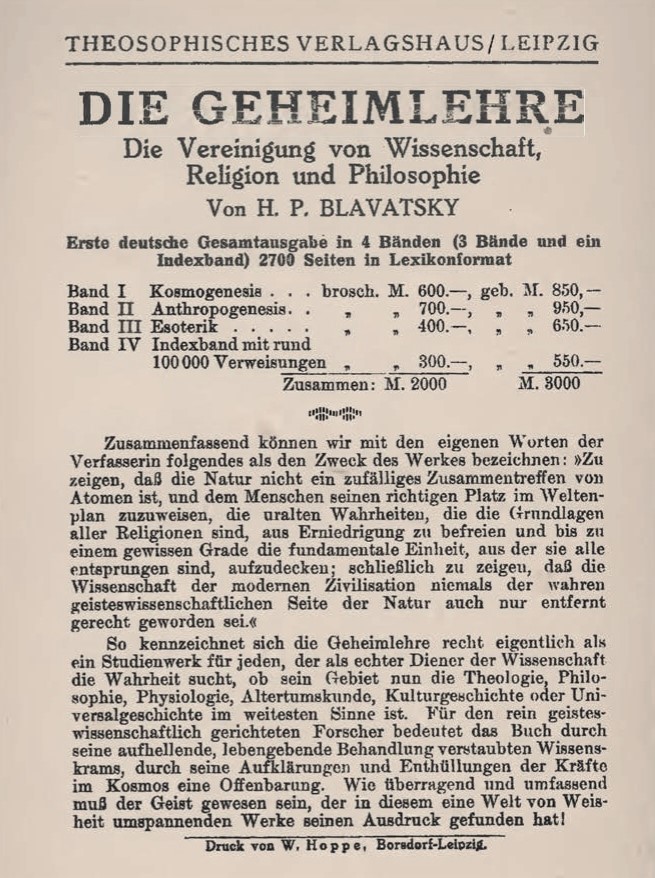
Publisher advertising of the German translation “Die Geheimlehre” of “The Secret Doctrine”, in: Franz Hartmann: Was ist Theosophie? (3. A., n.d. [1922])
Series of Publications
Theosophical Manuals (Adyar)
Theosophical Manuals (Point Loma)
Theosophische Handbücher
18 booklets.
Edited by Katherine Tingley, Point Loma. Translation of the Theosophical Manuals and print by J. Th. Heller, Nürnberg
Theosophische Strahlen zur Verbreitung der göttlichen Wahrheiten der Theosophie.
Edited by Paul Raatz, Theosophischer Verlag Berlin. 18 issues
Das Entwickeln der Konzentration.
No. 7/8: William Q. Judge – Okkulte Kräfte und deren Aneignung.
No. 10: Anna Vogel: Kampf der Wahrheit mit der Lüge. Eine Allegorie.
No. 13: Thomas Green: Theosophie und Naturwissenschaft oder die Grundlage der esoterischen Philosophie.
Wichtige Zeit- und Lebensfragen
Edited by Johannes Fährmann
Heft III. Verbrechen und Todesstrafe. Eine philosophische Betrachtung,
Leipzig: A. Frankes Verlag, 1904, 33, 4 pp. (sequential numbering of the series [5], 70-100, [4].
Traditional theosophy before 1875
In chronological order. First of all without the huge collections of Paracelsus, Jacob Böhme and Swedenborg.
„Was du ererbt von deinen Vätern hast,
Erwirb es, um es zu besitzen.“
- Goethe, Faust I, „Nacht“.
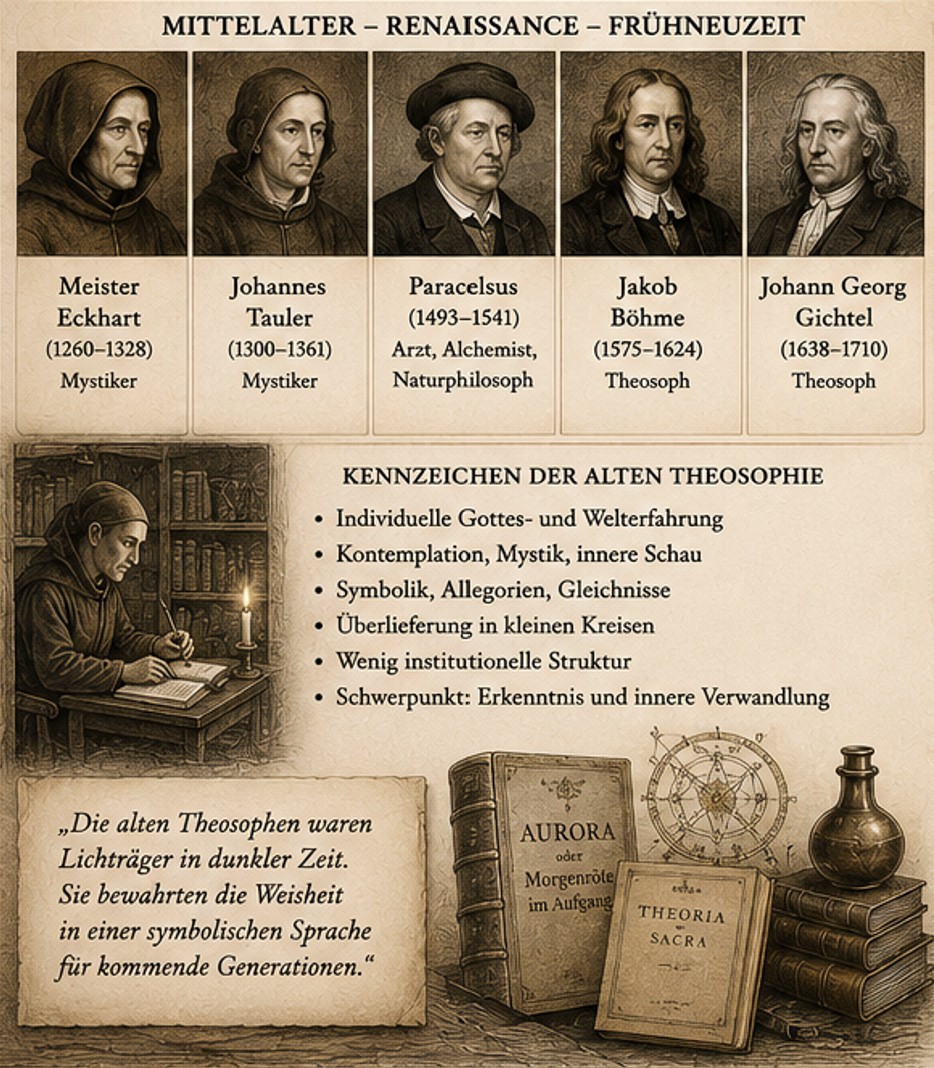
Spiritual (and organizational?) continuity of the Esoteric Tradition
Taking into account the Leo Strauss’s Hermeneutics (writing under censorship during the Inquisition up to the boycott of Blavatsky’s magazine Lucifer in London 1887)
1314 – Master Eckhart: Sermons, etc. Theology and philosophy are coequal. Biblical texts have a hidden meaning. Faith is not the end, but rather the beginning of a spiritual development towards knowledge. Everything created is finite and therefore not truly real. One cannot understand divine truth without first creating the prerequisites – whereby one must oneself become truth – for only truth can recognize truth.
1440 – Nikolaus von Kues: De docta ignorantia. Man gradually approaches the divine. Human beings possess the faculty of reason (intellectus) [buddhi-manas], which stands far above the understanding. It is capable of negating the understanding’s differentiating negation [kama-manas], thereby arriving at the concept of infinity and infinite unity. This concept is a content of reason and, as such, lies beyond the reach of the understanding’s activity.
1529/1530 – Paracelsus Volumen Paramirum and Paragranum (1530). His pupils called themselves theosophists
1612 – Jakob Böhme, book Aurora
1614 – pamphlet “Fama Fraternitatis” – A hidden brotherhood seeks a universal reformation of the whole society
1627 – Sir Francis Bacon: Invisible isle of Bensalem / Salomon’s House, where higher men live
1630 – A London College of Rosicrucians (Encyclopaedia Metropolitana, in: F. Leigh Garnder: A Catalog Raisonné of Works on the Occult Sciences, vol. I, Rosicrucian Books, Leipzig, 2nd ed. 1923, p. viii.
1787 – Eckartshausen encounters a wise stranger in Munich in the Nymphenburg Palace Park at the Isar river, who gives him a book as a gift. Begin of theosophical texts.
1790 – Eckartshausen: Writes about the encounter. Their 7th degree is “Lampadas”, higher initiates, teachers sent forth, hidden sciences
1792 – Eckartshausen writes that he is able to get proactive in touch with the Masters
1792-1797 – Theosophic Correspondence between Louis Claude de Saint-Martin and Nicolas Antoine Kirchberger, Baron de Liebistorf
1801 – Eckartshausen receives letters (plural) from Masters, of which an extract of a 1801 letter is published by Hartmann and HPB in The Theosophist in 1887
1802 – Eckartshausen in “Die Wolke”: inner community of light, children of light / higher school of the brothers of light, “bodily rebirth” (“leibliche Wiedergeburt”)
18th/19th – Saint-Germain, Cagliostro, reception of Paracelsus
1835 – Gustav Theodor Fechner was inspired by a wise Indian, Master K.H. met with him
1842 – Edward Bulwer-Lytton, Zanoni, subterranean worlds, encounters with Masters, launches a Theosophical Society in London
1855 – Agrippa von Nettesheim (Heinrich Cornelius) defines both Anthroposophy and Theosophy as doctrines of the “good science”.
1882 – Master K.H., Saint-Germain/Cagliostro as historical parallels
1884 – Master K.H. refers to HPB’s predecessors as “light-bearers of preceding generations”
1885 – HPB defines Saint-Germain, Cagliostro, Bruno, Paracelsus as maligned martyrs
1887 – Hartmann publishs the Rosicrucian Letters Series, parts I-VII, in The Theosophist and the rediscovery of the teachings of Paracelsus from rare works and unpublished manuscripts.
Old and modern theosophy
→ a primordial wisdom teaching
→ wisdom schools spanning millennia
→ inner and outer religion
→ various religions as expressions of a single truth (philosophia perennis), conditioned by time and culture
→ latent inner spiritual faculties of the human being
→ inner organ of perception, divine spark
→ development of the divine within the human being
→ struggle between lower and higher nature
→ regeneration/rebirth
→ the spiritual human
→ faith (pistis) evolving into experience and higher knowledge
→ individual regeneration expanding to the reformation of humanity
Conclusio: This is far more than merely the shared use of the word “Theosophy.”
Fama Fraternitatis: General Reformation
↓
Earlier Theosophy: inner church / school of wisdom / regeneration of the individual and humanity
↓
Eckartshausen: Community of Light / primordial deposit / “regeneration of humanity”
↓
Blavatsky: public and international theosophical movement / universal brotherhood / synthesis of religion, science, and philosophy / practical ethics
↓
Blavatsky, Convention Letters: practical realization of theosophy and reform of society
Year, name, title, edition, location, data
Format | Topics |
Digitized by; source
A selection of modern titles with a retroperspective
Jentsch, Carl: Umschlag der Philosophie in die Theosophie, in: Hellenentum und Christentum. Leipzig: Gronow, 1903, pp. 121-142.
book | neoplatonists, antiquity | dilibri
Merkel, Ingrid: Ch. Theosophie, Mystik, Pietismus, in: Barock. Handbuch der deutschen Literaturgeschichte, Abteilung Bibliographien, Band 5. Bern, München: Francke, 1971.
Breckling, Friedrich (1629-1711): Autobiographie. Ein frühneuzeitliches Ego-Dokument im Spannungsfeld von Spititualismus, radikalem Pietismus und Theosophie. De Gruyter 2005, 168 pp, reprint 2011.
Quellenbibliographie zur Seelenwanderung (Bibliography of Sources on soul wandering)
beginning with the year 1757, Freie Universität Berlin (2008-2012)
Forschungsbibliographie zur Seelenwanderung (Research bibliography on soul wandering)
Prof. Dr. Jutta Müller-Tamm unter redaktioneller Mitarbeit von Dr. Kyung Ho Cha und Martin Hense.
Wehr, Gerhard: Theo-Sophia. Christlich-abendländische Theosophie. Eine vergessene Unterströmung. Dietzenbach: Die Graue Edition, 2007, 322 pp. Review by the Official Protestant Central Office for Worldview Issues, where the author Werner Thiede criticizes the fact that Wehr also places Steiner within this Christian-theosophical tradition, even though Steiner teaches reincarnation, unlike Böhme and Swedenborg. For usual the theologians ignore the reasons for this, which were the deadly intolerance against any higher or esoteric knowldge above the dead-letter interpretation of the Holy Bible.
Also a review in the anthroposophical magazine Die Drei 02/2008 by Klaus J. Bracker. To Bracker wisdom with its expression of the inner divine fullness and, at the same time, as a self-manifesting human capacity, it is precisely this that transforms the mystic into a theosophist. This then led to persecution as a result of the open practice of mysticism or theosophy as a practical discipline. The resulting persecution endured by Jakob Böhme, the cobbler from Görlitz, is a prime example of this. A world of ideas, a cosmos of theosophical endeavor, which, as a complement to the academic history of philosophy, should be conceived of as deeper and more radiant than previously imagined.
Bracker claims, in the usual anthroposophical narrative, that the term theosophy as a name of a genuinely European movement is being used by Blavatsky in a way that is almost alien to its essence. He ignores the broader view by Blavatsky herself, that she and her teachers did not follow up only to the Christian theosophists but especially to the theosophists around Plotin and Ammonius Saccas.
Kanzian, Dr. Oskar: Das Gottesbild in der christlichen Theosophie und die Macht der feinstofflichen Kräfte. Manuskriptdruck. Arcturus Verlag, 2016 A-8244 Schäffern, 45 pp. Abstract: “Das Gottesbild in der christlichen Theosophie und die Macht der feinstofflichen Kräfte Der heute im Westen verbreiteten Theosophie wird oft der Vorwurf gemacht, dass sie aus einem fremden, asiatischen Kulturkreis stamme und sie keine Verwurzelung in der westlichen Kulturtradition habe. Tatsächlich gibt es aber eine solche westliche theosophische Kulturtradition, sie ist leider seit den großen Erfolgen der vom indischen Adyar ausgehenden theosophischen Gesellschaften in den Hintergrund geraten und sie gilt als weniger attraktiv und faszinierend, da sie sich nicht mit den besonderen psychischen Schaustellungen asiatischer Innenkräfte rühmen kann. Die westliche Theosophietradition ist ferner durch den dogmatisch bedingten Niedergang der spirituellen Kirchenkulturen in Verruf geraten und sie wird noch zusätzlich von der Anthroposophie attackiert, die sich ausschließlich auf das Werk ihres Gründerphilosophen Rudolf Steiner stützt, dem nicht selten von seinen Anhängern absolute Unfehlbarkeit und Allwissenheit bescheinigt wird. Zudem gibt es auch in den aus Indien stammenden Theosopieschulen viele Propagandisten für den theoretischen und praktischen Atheismus, ein Kuriosum, wenn es sich um eine theosophische Gesellschaft handelt.”
Weber, Jörg: Die Theosophie des Dionysius Areopagita. Eine Einführung in die christliche Theosophie III. disserta Verlag 2016, pdf.
Abstract: “Die Schriften des Corpus Areopagiticum sind beseelt vom Wurzelbewusstsein des esoterischen Christentums. Sie stehen in der uroffenbarungsgeschichtlichen Tradition einer prisca sapientia, die das verborgene Wesen des Christentums dem Menschen durch eine Geheimlehre zugänglich zu machen beabsichtigt. Die christliche Geistlehre des Dionysius steht damit aber in einem grundlegenden Spannungsverhältnis zur Theologie, die als kanonisches Wissen von der Offenbarung den Hieratismus des kirchlichen Kultsystems selbst für Mystagogie, das heißt für das Arkanum des Christentums ausgibt. Nach Dionysius ist Mystagogie aber nur dann von göttlicher Herkunft, wenn die selbstentäußerte Gottheit des Logos sich als Antlitz Jesu im gottförmigen Nous des Mysten selbst inkarniert. Vergöttlichung ist Schau, die der Nous des Mysten von der in ihm fleischgewordenen Gottheit Jesu selbst aktuiert. Sie ist theosophische Erkenntnis der sich im Nous ereignenden Kenosis Jesu, die der Nous selbst macht, weil sie ganz seine ist. Die göttliche Arkanwissenschaft der Mysten Jesu wird von Dionysius in der Schrift Über die mystische Theologie als die Theosophie der Christen (MTh I, 1; 997 A) bezeichnet.”
Chronological Order
c. 300 A.D .: Jamblichus – Περί των Αγυπτίων μυστηρίων (Peri ton Aigyption mysterion, ,, Uber die Mysterien der Agypter”). Greek original lost. Latin: De mysteriis Aegyptiorum. First German translation by Dr. Theodor Hopfner of the Parthey edition of 1857 as Über die Geheimlehren, Leipzig, Theosophisches Verlagshaus 1922, Über die Geheimlehren, xxiv+277+3 pp.
Reprint by Georg Olms Verlag, 1987, 2nd printing 2013, 302 pp. Hopfer gives in his foreword the following history of editions: 1497: Latin translation by Marsilio Ficino (excerpts only); 1556: complete Latin translation by Nicolaus Scutellius; 1678: first printed Greek edition by Thomas Gale in Oxford, 316 pp; 1857: critical Greek edition by Gustav Parthey in Berlin, from the manuscript codices copies, with overview of the Gale edition, LVI+328 pp.
book | mysteries and secret doctrines of the Egypts | Google
1459: Johann Valentin Andreae: Chymische Hochzeit des Christiani Rosencreutz
book | rosicrucians, alchemy | Odyssee Theater
1517: Gabriel Biel (1418-1495): Sacre theosophie lice[n]tiati nostre te[m]pestatis p[ro]fundissimi: sacri canonis misse tum mystica tu[m] literalis expositio : iamia[m] summa dilige[n]tia iterum atq[ue] iteru[m] reuisa et correcta. In famatissimo Lugdunen[si] emporio [Lyon]: Cleyn, 1510 [568 pp.]; 1517 [544 pp.].
1580: Bernhard Haus: Χρησμοὶ τῶν Ἑλληνικῶν θεῶν (Oracular Pronouncements of the Greek Gods). In 1580, Haus copied this Greek text for his teacher Martin Crusius from the Codex Argentoratensis gr. IX, a manuscript formerly owned by Johannes Reuchlin. The text is a Byzantine excerpt from a Late Antique work by an unknown Christian author, dated to around 500 CE. The title of at least the first and most extensively excerpted book of the originally four-volume work was Θεοσοφία (Theosophia); by current scholarly consensus, this title is used for the entire work. The surviving Byzantine excerpt is known as the Tübinger Theosophie (Tübingen Theosophy), a modern designation referring to its present location in Tübingen.
First German translation: Laura Carrara and Irmgard Männlein-Robert: Die Tübinger Theosophie, Stuttgart: Anton Hiersemann, 2018, with an afterword by Helmut Seng, IX, 362 pp.
1678: Musaeum Hermeticum Reformatum Et Amplificatum. Introduction by Karl R. H. Frick, M. D. in the reprint of 1970.
1697: Theosophical Transactions of the Philadelphian Society, London 1697. Extracts. Comment by Dr. Lian Temple and article Who were the Philadelphian Society?; cp. Richard Roach.
1709: Johannes Richtenfels (pseudonym): Theosophischer Wunder-Saal, published by Theophilus Philalethes in Corintho (fictitious location for Tübingen). The author describes himself as “Promotoris Edlen Ritters von Orthopetra, K. S. u. F. S. R.”, which is: “Kayserlicher Spagnolischer und Frantzösischer Rath“ (modern: “Kaiserlicher Spanischer und Französischer Rat”). The official abbreviation is used for the double, secret meaning of “Frater Sanctae Rosae [Crucis].” The literal translation into modern English is: “Promoter of the Noble Knight of Orthopetra, Imperial Spanish and French Counsillor”, the esoteric reading is: “Promoter of the Noble Knight of the Right Stone, Brother of the Holy Rose [Cross].”
The fictitious loacation “Orthopetra” is a combination of the two Greek terms: orthos (ὀρθός): upright, straight, correct, truthful, and of petra (πέτρα): the stone, the rock, meaning “upright stone” or “right stone” (or the Philosopher’s Stone, Lapis Philosophorum).
1742: ERNST AUGUST, Herzog von Sachsen-Weimar (1688-1748) – Zu dem hoechsten alleinigen Iehovah gerichtete theosophische Herzens-Andachten oder Fürstliche selbst abgefassete Gedancken, wie wir durch Gottes Gnade uns von dem Fluch des Irdischen befreyen und im Gebet zum wahren Lichte und himmlischen Ruhe in Gott eingehen sollen : nebst einigen aus dem Buch der Natur und Schrifft hergeleiteten Philosophischen Betrachtungen von denen dreyen Haushaltungen Gottes im Feuer, Licht und Geist zur Wiederbringung der Creatur / [Das kurze Glaubens-Bekenntniß des Hoch-Fürstlichen Auctoris.]. o. Ort, o. Verleger, 1742, in-4to, Kupfertitel + 148 S, Einfacher-Pappband d. Zeit. Erste Ausgabe.
book | Bohemian or Christian Theosophy | Google
1780: Gotthold Ephraim Lessing – Die Erziehung des Menschengeschlechts, Berlin: Voß, 1780, 90 pp. In this famous work he introduced in the paragraphs 94 to 100 the idee of soul wandering (reincarnation). “Why couldn’t every single person have been in the world more than once? Is this teaching so ridiculous simply because it is the oldest?” and ““Why shouldn’t I come back as often as I am able to acquire new knowledge and new skills?”
1785: Hinricus Madathanus Theosophus – Geheime Figuren der Rosenkreuzer, aus dem 16ten und 17ten Jahrhundert. Aus einem alten Mscpt zum erstenmal ans Licht gestellt. Erstes Heft, 58 pp. Altona 1785-1788 in drei Heften. Comm. by Rudolf Steiner.
book | rosicrucians, alchemy | Odyssee Theater
1786: Johann Gottlieb Stoll – Etwas zur richtigen Beurtheilung der Theosophie, Cabbala, Magie und anderer geheimer ubernaturlicher Wissenschaften. Nebst einem Kupfer. 174 pp., Leipzig [publisher unknown] 1786.
Critique of Occult Sciences: A factual and incisive examination of Theosophy, Kabbalah, and magic. Exposing Deception: Classifying so-called Theosophists as alleged hypocrites who claim to have renounced worldly things but in reality strive for goldmaking in alchemy. Target audience of the critique: The observation that such heresies are widespread not only among the common people but especially among scholars, doctors, and preachers.
book | criticism of Theosophy | MDZ, Internet Archive
1791/1800: Heinrich Zschokke (1771-1848) – Schwärmerei und Traum, in Fragmenten und Dialogen.
With only 19 years old he advocated the idea of reincarnation under the pen name of Johannes von Magdeburg. Stettin: Johann Sigismund Kaffke, Vol. I, 1791, Vol. II, 1794).
Reprint under his name as new chapter headline Vergangenes Seelendasein und dereinstiges, in renamed volumes as: Kleine Schriften, vol. I of II, pp. 31-72, Stettin: Johann Sigismund Kaffke, 1800.
He deals with reincarnation in three chapters of vol. I of Kleine Schriften:
– Kapitel II: Vergangnes Seelendasein und dereinstiges
– Kapitel VI: Dialog in einer Abendstunde. Eine Fortsezzung des Aufsazzes über
vergangenes und dereinstiges Seelendasein
– Kapitel VIII: Joh. v. Magdeburg und Myron, über die Möglichkeit der Hypothese von
der Präexistenz und Seelenwanderung
Reprint of the chapter Vergangenes Seelendasein und dereinstiges by Kommissions-Verlag J. W. Basedow, Hamburg 1905, 32 pp. The twin doctrine of karma and reincarnation to ever higher levels, 88 years before Blavatsky’s public dissemination. Here Blavatsky is vindicated from the accusation that her theosophy shares only the name—and not the substance—of the earlier theosophy. The anonym editor of 1905, a “K. S. K.” regards Zschokke as “proclaimer of the theosophical ethics (“Verkündiger der theosophischen Ethik”), p. 5. Vienna occultist Hofrath Prof. Max Seiling concludes in the Psychische Studien of August 1905: “The doctrine of karma, too, is in striking agreement with theosophy”.
Also reviewd in The Theosophical Review of January 1906 by E. K. on p. 472: “It is interesting to Theosophists to find a German thinker more than a hundred years ago, setting forth the doctrine of man’s previous and future existences and demolishing the idea of the resurrection of this earthly body, on purely rationalistic grounds, and this without any reference to Eastern teachings. He argues that as all Nature proceeds by gradual development, therefore nothing is destroyed; its form only is changed, and man’s thinking part must of necessity find new fields and new bodies in which to function from life to life, losing nothing of what he has already gained, but using the powers formerly acquired, though he may not be conscious of their origin. In fact, all the arguments for reincarnation either on this planet or elsewhere are set forth even to the minutest details, arguments which are now beginning to find a wide hearing in this Western world of ours.”
The review by Arthur Weber in the Theosophischer Wegweiser 1906, no. 6, p. 172-177, acknowledges Zschokke’s doctrine of repeated existences, developed in 1800, as a remarkable precursor to the theosophical doctrine of reincarnation; however, it expressly distances itself from his notion that the soul inhabits a different planet with each new existence. According to theosophical understanding, the Earth serves as the “school” for repeated human incarnations during a planetary evolutionary period; only after the completion of this Earth period does a new stage of planetary evolution follow. The 1906 review in The Theosophical Review puts it more cautiously, stating that Zschokke developed arguments for reincarnation “either on this planet or elsewhere.”
book | reincarnation and karma | 1791: none; 1800: Univ. of Göttingen; 1905: none
1791: Karl von Eckartshausen: Aufschlüsse zur Magie, Teil I, 2. Auflage, München 1791. On p. 42 about higher developed men: „Vollkommner sind unsere Brüder auf der Stufenfolge als wir; also auch der Gottheit ähnlicher, und der reinen Liebe näher; daher müssen sie auch mit uns näher verbunden seyn. Sie sind unsichtbar unsers Glücks Theilnehmer — unsrer Geschäfte Brüder.“
Eckartshausen mentions also his physical meet in 1790 with a stranger in Munich at the Isar river in the garden of the palace (Nymphenburg Palace Park) on p. 188 f.:
„Tief über diese Sache nachdenkend saß ich einst auf einer Rasenbank im Garten an der Burg, als mich jähling die ehrwürdige Miene eines Mannes aufmerksam machte…“
1792-1797: Theosophic Correspondence between Louis Claude de Saint-Martin and Nicolas Antoine Kirchberger, Baron de Liebistorf.
Printed 1863 by William Roberts Edition, Exeter, reprint Covina: Theosophical University Press 1949, xxxii, 326 pp., reprint Pasadena: Theosophical University Press, 1982, xxxii, 326pp.
1792: Johann Gottfried Eichhorn, Urgeschichte, hg. mit Einleitung und Anmerkungen von Johann Philipp Gabler.
Altdorf und Nürnberg: Monath und Kußler, 1792, XXXII + 670 pp. Gabler uses here for the first time in the German language the noun “Esoterik” on p. 327, vol. I, second part.
Entdeckerin Monika-Neubauer-Wölk: “In einem Text von 1792 fand sich das Stichwort Esoterik in seiner deutschen Sprachform. Dieser Fund war völlig unerwartet, und ich begann sofort damit, den Kontext zu erarbeiten. Zwischen 1790 und 1793 war eine mehrbändige Arbeit des Göttinger Professors für Orientalische Sprachen Johann Gottfried Eichhorn (1752–1827) mit dem Titel Urgeschichte erschienen.22 Deren erste Fassung von 1775/79 war noch anonym herausgekommen,23 zu Beginn der neunziger Jahre hatte dann sein Schüler Johann Philipp Gabler (1753–1826) das Werk unter dem Namen Eichhorns neu ediert und mit aktualisierenden Annotationen versehen.24 In einer dieser neuen Anmerkungen liest man von der „Esoterik des Ordens“ der antiken Pythagoreer.25 Dies ist der früheste Beleg für das deutsche Wort Esoterik, der uns bis heute bekannt ist. Auch in den anderthalb Jahren zwischen seiner Entdeckung und der Niederschrift dieses Beitrags für den Tagungsband fand sich kein noch weiter zurückliegendes Zitat.”
– Monika Neugebauer-Wölk: Historische Esoterikforschung, oder: Der lange Weg der Esoterik zur Moderne, p. 41, in: Hallesche Beiträge zur Europäischen Aufklärung 50, Berlin/Boston: Walter de Gruyter GmbH, 2013, 78 pp.
Julian Strube writes in his dissertation Sozialismus, Katholizismus und Okkultismus im Frankreich des 19. Jahrhunderts of 2015 on fn. 71 on p. 19, that Neugebauer-Wölk has in the meantime the noun Esoterik in German works already in the year 1770, but he gives no details.
1795: Letter of Karl von Eckartshausen to Kirchberger from March 19th, 1795.
“Fifteen years ago, such an experience would have aroused my keenest curiosity; now—I know not what has come over me—it elicits nothing but indifference.”
“In the space separating the world from the celestial realm lies the intermediate world—the most dangerous of all—because most people seeking to ascend to the higher realm must necessarily pass through this middle one, unaware that it is fraught with snares and temptations.”
He writes further about spiritual experiences, teachings “from above,” a higher presence, and visions and shows his theosophical development. Archives: Correspondance de Kirchberger avec Eckartshausen – Ms. T.S. 1027, Bibliothèque de la Faculté de théologie Libre in Lausanne.
Faivres Eckartshausen et la théosophie chrétienne (1969) contains an excerpt from a letter from Eckartshausen to Kirchberger about “les révélations de l’ange”, “the revelations of the angel”.
18xx : Hanka – Ueber Theosophie in Bezug auf Arzneikunde, listet in: 48. Jahresbericht der Schlesischen Gesellschaft fur vaterlandische Cultur, Breslau 1871, p. 301
fn.
article | medicine | none
1802: Karl von Eckartshausen: Die Wolke über dem Heiligthum, oder Etwas, wovon sich die stolze Philosophie unsers Jahrhunderts nichts träumen lässt
[no location, no printer] 1802, 91, 1 pp. 2nd, unchanged printing Munich: Lindauer 1823, 91, 1 pp.
On p. 1: “War of the animal man against the spirit-man.” (“Krieg des Thiermenschen gegen den künftigen Geistmenschen.”)
on p. 3-4: “This is the pass to which the contemporary Enlightenment has come: its autonomy—cloaked in philosophical hypocrisy—is the offspring of the very ruin it has brought upon the world.”
On p. 23: “Der Unglaube brachte das Verderben aufs höchste, man suchte selbst das Gebäude des Christenthums in seinen ersten Gründen anzugreifen, und vermischte das heilige Innere mit dem Aeußern, das den Schwächen und der Unwissenheit gebrechlicher Menschen unterworfen war.
Es entstand der Deismus, dieser erzeugte den Materialismus, welcher allen Zusammenhang des Menschen mit höheren Kräften für Einbildung hielt, und endlich eine gänzliche Gottesverläugnung – theils durch Verstand, theils durch das Herz, die höchste und letzte Erniedrigung des Menschen.
Bey allem dem blieb die Wahrheit im Innern immer unerschüttert.”
On p. 36: “Do not ask who the people writing to you are.” („Fragen Sie nicht, wer die sind, die an Sie schreiben…“)
On p. 77: “physical rebirth” (“leibliche Wiedergeburt”).
1819: Karl von Eckartshausen: Über die Zauberkräfte der Natur. Eine freie Uebersetzung eines Egyptischen Manuscripts in coptischer Sprache. Mit einem Anhange eines aus magischen Chrakteren entzifferten Manuscripts. Ein nachgelassenes Werk.
Munich: Joseph Lindauer, 1819, XXVIII, IV, 100, 3 pp.
1823: Karl von Eckartshausen: Über die wichtigsten Mysterien der Religion. Nebst einem Anhang – Fragmente aus der altesten Weisheitsschule: oder Cloas, des Naturpriesters: Unterricht an Sophrom. Munich 1823, 142 pp. Reprint Munich 2020, 140 pp.
book | science of the holy ones, inner wisdom school, the closed kingdom of heaven within us | Google
1828: Isaac J. Schmidt – Über die Verwandtschaft der gnostisch-theosophischen Lehren (1828), 25 pp.
article | relationship between gnosticism and theosophy | Google
1831: August Gförer: Kritische Geschichte des Urchristenthums, erster Band in zwei Abtheilungen: Philo und die alexandrinische Theosophie, oder vom Einflusse der jüdisch-ägyptischen Schule auf die Lehre des neuen Testaments. Erster und zweiter Theil. Stuttgart: E. Schweizerbart’s Verlagshandlung, 1831, two vols., XLIV, 534, 2 and 406, 2 pp.
book | early Christianity, Philo of Alexandria’s theosophy | Google
1835: Gustav Theodor Fechner – Das Büchlein vom Leben nach dem Tode (ed. 1947, without annotations, with epilogue). Master K.H. talked with him in Leipzig.
booklet | after life | unknown, sending
1850: Mystik und Theosophie. Bucher-Auktion bei Fr. Hanke, Buchhandler und Antiquar, Katalog No. 29 with over 8,000 items, 240 Nrn. items of mystic and theosophy; two advertisements for the book auction on April 6, 1850 in: Tagblatt der Stadt Zürich, Nro. 82, 23 March 1850, p. 423, par. 12 and in Nro. 96, April 6, 1850, p. 498, par. 70.
newspaper advertisement of a book auction | mysticism and theosophy | Google
1851: Gustav Widenmann: Gedanken über die Unsterblichkeit als Wiederholung des Erdenlebens. Mit einem Aufsatz von C. S. Picht: “Das Abtauchen der Reinkarnationsidee bei dem Arzt und Philosophen G. Widenmann 1850”. Wien, 1851, x + 96 p.
1855: Agrippa von Nettesheim (Heinrich Cornelius) Magische Werke – Sammt den geheimnißvollen Schriften d. Petrus v. Abano, Pictorius v. Villingen…; Zum ersten Male vollständig ins deutsche übersetzt; Vollständig in fünf Theilen, mit einer Menge Abbildungen. Stuttgart: Scheible, 1855. 367, 1 pp.
Defines on p. 156 both Anthroposophy and Theosophy as doctrines of the “good science”.
book | mystic, alchemy, magic, theosophy | MDZ
1855: Introduction to Theosophy, or the Science of the Mystery of Christ; that is, of Deity, Nature, and Creature, embracing the philosophy of all the working powers of life, magical and spiritual, and forming a practical guide to the sublimest purity, sanctity, and evangelical perfection; also to the attainment of divine vision, and the holy angelic arts, potencies, and other prerogatives of the regeneration, London 1855.
The following is the dedication of this volume: “To the students of Universities, Colleges, and schools of Christendom: To Professors of Metaphysical, Mechanical, and Natural Science in all its forms: To men and women of Education generally, of fundamental orthodox faith: To Deists, Arians, Unitarians, Swedenborgians, and other defective and ungrounded creeds, rationalists, and sceptics of every kind: To just-minded and enlightened Mohammedans, Jews, and oriental Patriarch-religionists: but especially to the gospel minister and missionary, whether to the barbaric or intellectual peoples, this introduction to Theosophy, or the science of the ground and mystery of all things, is most humbly and affectionately dedicated.” Quoted from Dr. J. D. Buck in Helena P. Blavatsky – The Key to Theosophy (1889).
1855-1857: Johann Scheible: Kleiner Wunder-Schauplatz der geheimen Wissenschaften, Mysterien, Theosophie, göttlichen und morgenländischen Magie, Naturkräfte, hermetischen und magnetischen Philosophie, Kabbala und andern höhern Kenntnissen, Divination, Offenbarung, Vision, Combination und schwer begreiflichen Thatsachen. Book series in 14 parts, Stuttgart 1855-1857. Reprint: Edition Ambra, Aurum Verlag, Freiburg 1978-1979.
1856 : Theosophical Miscellanies, follow-up volume of 1855, 600 pages, royal octavo, diamond type. Quoted from Dr. J. D. Buck in Helena P. Blavatsky – The Key to Theosophy (1889).
book | theosophy and mystic | none
1860: Eduard Emil Eckert: Die geheimen Mysterien- Gesellschaften der alten Heidenkirche bis zu der, im Bunde der Manichäer oder der alten Kinder Wittwe, zum Zweck der geheimen Erhaltung und einstigen Wiederherstellung der alten Heidenkirche, geschehenen Umgestaltung; treu dargestellt und erklart in ihren Wesen, Organismen, Statuten, Ritualen und Symbolen, zum Behuf: einerseits sie in ihrer Wahrheit zu zeigen, andererseits zur endlichen vollständigen Enthüllung des heutigen Bundes der Kinder der Wittwe des sogenannten Freimaurer-Ordens mit seiner Schwesterschaft. Schaffhausen: 1860, XLIII, 260 pp.
book | pagans, heathens, druids, celts | Google
1861: Jürgen Bona Meyer – Die Idee der Seelenwanderung. Vortrag gehalten im wissenschaftlichen Verein zu Berlin. 62 pp., Hamburg: Otto Meissner, 1861.
booklet | soul wandering; Lessing; reincarnation; rebirth | none
1865: Karl Philipp Fischer – Zur hundertjährigen Geburtsfeier Franz von Baaders – Versuch einer Characteristik seiner Theosophie und ihres Verhältnisses zu den Systemen Schellings und Hegels, Daubs und Schleiermachers. Erlangen: Besold, 1865, IV, 71 pp.
1875: James Ralston Skinner – The Source of Measures: Key to the Hebrew-Egyptian Mystery, Philadelphia 1875, xvi, 324, 63 pp. New edition Independently published 2021, 359 pp., with annotations by Sonchis Triacorda.
Blavatsky described this work as an exposition of one of the seven keys that allow the complete understanding of the biblical message. He shows that the numerical mystical system of the Kabbalah are coming from the esotericism of the Egyptians. Skinner proceeds to minutely describe the great and overwhelming correspondences existing between the construction measurements of the Great Pyramid of Giza and those of the Temple of Solomon.
P. 306: “CONCLUSION TO APPENDICES. Authorities for an Esoteric Reading of the Bible. § 97. As is seen, the great display of the creative law of measure among the Egyptians was in that “wonder of the world,” the great pyramid. Among the Hebrews it was in (I.) the Garden of Eden; (2.) the Ark of Noah; (3.) the Tabernacle; and (4.) the Temple of Solomon. Around these actual displays, description was conveyed by the hieroglyphic reading of the narratives of the Holy Writ. “Wo be to the man who says that the Doctrine delivers common stories and daily words! For if this were so, then we also in our time could compose a doctrine in daily words which would deserve far more praise. If it delivered usual words, then we should only have to follow the lawgivers of the earth, among whom we find far loftier words to compose a doctrine. Therefore, we must believe that every word of the Doctrine contains in it a loftier sense and a higher meaning. The narratives of the Doctrine are its cloak. The simple look only at the garment–that is, upon the narrative of the Doctrine; more they know not. The instructed, however, see not merely the cloak, but what the cloak covers.” (The Sohar, 11I, 152 ; Franck, 119.) So the Church: “If we hold to the letters, and must understand what stands written in the law after the manner of the Jews and common people, then I should blush to confess aloud that it is God who has given these laws : then the laws of men appear more excellent and reasonable.” (Origin, Homil. 7, in Levit.) “What man of sense will agree with the statement that the first, second, and third days in which the evening is named, and the morning, were without sun, moon, and stars, and the first day without a heaven? What man is found such an idiot as to suppose that God planted trees in Paradise, in Eden, like a husbandman, etc .? I believe that every man must hold these things for images under which a hidden sense lies concealed.” (Origin ; Huet. Originiana, 167; Franck, 121, quoted from Sod. “Genesis,” p. 175.) “THE MYSTERIES OF THE FAITH NOT TO BE DIVULGED TO ALL. But since this tradition is not published alone for him who perceives the magnificence of the word, it is requisite, therefore, to hide in a mystery the wisdom spoken, which the Son of God taught.” (Clemens Alexandrinus, Strom. 12.) “For we shall find that very many of the dogmas that are held by such sects (of barbarian and Hellenic philosophy) as have not become utterly senseless, and are not cut out from the order of nature,” are held in common with us, the token of recognition being “by cutting off Christ.” (Same, Strom. 13.) The following reflections and notes seem appropriate as pointing an application of these statements in various phases of a same system; it being premised that the germ or key of all these hidden meanings lay in the possession of the method of measure, and in the measure which the Lord God used in the construction of the universe.”
1891: Kuno Fischer: Theosophie des Julius, in: Schiller als Philosoph, 2nd. rev. and augm. ed. in two vols., Heidelberg: Carl Winter’s Universitätsbuchhandlung, vol. I, pp. 59-69.
1891: Otto Pfleiderer – Fünftes Capitel. Schelling’s Naturphilosophie und Theosophie, in: Die Entwicklung der protestantischen Theologie in Deutschland seit Kant und in Großbritannien seit 1825, Freiburg i. B.: Mohr, 1891, pp. 58-63.