
Preserve • Make Accessible • Research • Inspire
A statement of principles
I. Why Theoarchive?
The study of Theosophy spans more than two millennia and embraces diverse philosophical, religious, and esoteric traditions. Despite the growing availability of digital sources, the field remains fragmented. Primary texts, secondary literature, bibliographies, terminology, and research tools are dispersed across numerous collections and often lack systematic organization.
Theoarchive was created privately in Berlin in 1994 to help overcome this fragmentation by providing a coherent research environment that preserves sources, organizes knowledge, and supports future scholarship.
II. Mission
Theoarchive seeks to preserve sources, organize knowledge, identify research gaps, and provide reliable tools both for the academic and theosophcial study of Theosophy. Rather than establishing conclusions, it aims to improve the conditions under which well-founded scholarly conclusions can be reached.
III. Our Principles
1. Scholarly Neutrality
Theoarchive does not promote or defend any religious, philosophical, or ideological position. Its purpose is to support scholarly investigation based on historical evidence, critical analysis, and transparent documentation.
2. Preservation of Knowledge
Historical sources are valuable cultural documents. Theoarchive seeks to preserve, document, and make accessible both primary and secondary materials for present and future generations.
3. Open Research
Research advances through openness, verifiability, and collaboration. Theoarchive encourages critical discussion, interdisciplinary dialogue, and continuous improvement of its resources.
4. Historical Context
Concepts, ideas, and traditions should be understood within their historical context. Similar terminology does not necessarily imply historical continuity or direct influence; such relationships require careful historical investigation.
5. Long-Term Perspective
Theoarchive is conceived as a long-term research infrastructure whose resources can continuously grow, evolve, and be refined as new knowledge becomes available.
Transition to KIT
The principles outlined in this manifesto are implemented through our Knowledge Infrastructure of Theosophy (KIT), which provides the conceptual and organizational framework of Theoarchive.
Visual Overview of our Research Programme
THEOSOPHY: CONTINUITY OR RUPTURE?
A conceptual, historical, and source-critical investigation
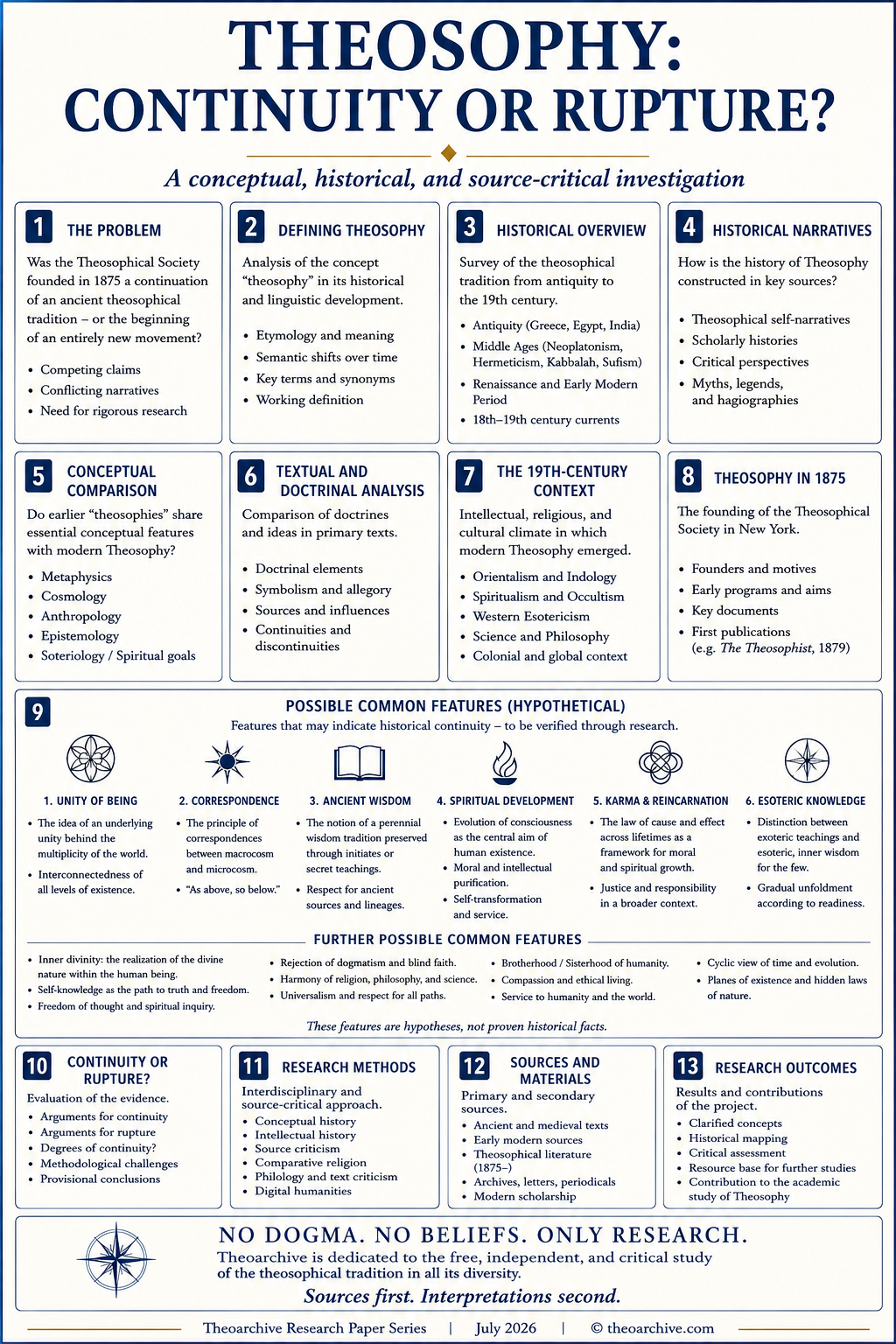
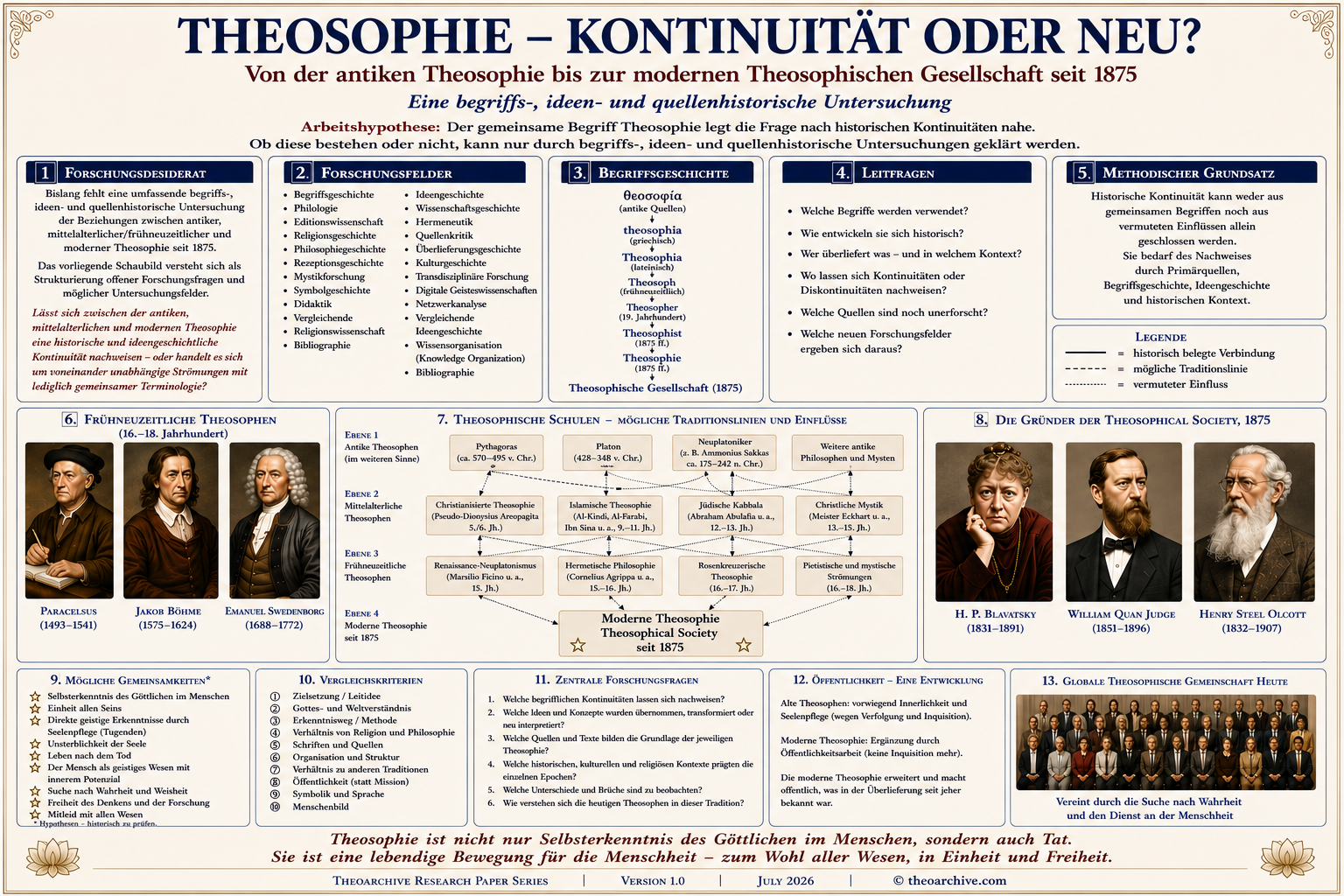
For your information we show also a former German version:
The following Knowledge Infrastructure of Theosophy (KIT) provides the conceptual framework through which these principles and research objectives are put into practice.
Our project Knowledge Infrastructure of Theosophy (KIT)
Guiding questions
• What do we know?
• What do we not yet know?
• Which sources are missing?
• Which research gaps and new research fields emerge?
1. Subject Matter
Theosophy is examined neither as a system of belief nor as a mere historical curiosity. It is understood as a complex phenomenon in the history of ideas.
It is not a history of religion, nor a history of esotericism alone, it is also a history of science.
Understanding significant thinkers is not a static state but an ongoing historical process. The aim of this KIT project is therefore not to provide a definitive explanation or assessment of Helena P. Blavatsky, but rather to make her writings accessible anew through a comprehensive analysis that is both source-critical and transdisciplinary.
They are intended to identify open research questions, unlock sources, and stimulate further scholarly inquiry. The aim is to advance the research of Theosophy through verifiable research questions, transparent methodology, and interdisciplinary dialogue.
This KIT project does not proceed from the question of whether Helena P. Blavatsky’s teachings are true or false. Instead, it starts by asking what epistemological program underlies her work, how that work is to be situated historically, and what research tasks arise from it for the present day.
2. Research Philosophy (Why?)
The project’s scientific self-conception.
Guiding principles:
• Seeking truth rather than dogmatism
• Sources over opinions
• Findings over interpretation
• Openness to competing hypotheses
• Integration of science, religion, and philosophy
• Transdisciplinary collaboration
• International research
• Knowledge acquisition as an open process
3. Research Infrastructure (With what?)
Creating the prerequisites for scientific research.
Preserve
Securing sources
• Books
• Journals
• Letters
• Manuscripts
• Archives
• Photographs
• Ephemera
• Digitization
4. KIT preservation of sources
Securing sources, digitizing, OCR
5. KIT makes accessible
Digital copies available online free of charge.
6. KIT research
Research Fields, Research Projects, Editions, Monographs, Dissertations
7. KIT Research Map (Where?)
Systematic mapping of the entire research field. This map is intended to make visible
• what is known,
• what is unknown,
• where sources are located,
• which methods are suitable.
State of research, research gaps (desiderata), research questions, research areas, priorities.
8. KIT methodology
Manifesto, transdisciplinarity, Methods, Understanding of Science
8.1. KIT transdisciplinarity
Ancient Greek and Latin, Buddhist studies, church history, comparative religion, didactics (differences and similarities between Blavatsky’s spiritual teaching method and the teaching methods of modern Western science, digital humanities, Early Christianity, editorial studies, education, Egyptology (Symbolism), esotericism, gnosticism, hermeneutics (internal and external impact of theosophical teachings), history of reception, history of science, indology, medicine, mythology, network analysis, parapsychology, philology, philosophy, psychology, Q question for the gospels, sociology, theology.
9. KIT inspires
Research Agenda, new projects, cooperations, future research
Although developed for Theosophy, the Knowledge Infrastructure of Theosophy (KIT) is conceived as a transferable framework for the preservation, organization, accessibility, and advancement of knowledge in other humanities disciplines.
10. KIT research areas (What is being worked on?)
Specific individual projects.
For example:
• Reception of German-speaking thinkers in The Theosophist
• Difference or similarities of the terms Theosopher / Theosophist
• German theosophical artist Sulamith Wülfing: Complete scientific bio bibliography (with place of publication, publisher, edition, number of pages, printing technique and all volumes I–XVIII)
• HPB’s understanding of science
• Mahatma Letters
• Franz Hartmann
• Symbolism of the seal
• History of the TS
• European reception
• German translations
• Relationship to Buddhism
• Relationship to Anthroposophy
• Women in early Theosophy
• Networks of the early movement
• Dictionary of technical theosophical terms from Englisch to German
Version 1.0 • July 2026 • © Theoarchive.com